A Two-Step Quantum-Classical Threshold at
13.1
22.6 µ
g with Exact Ratio
√
3
from a Close-Packed Vacuum Lattice
Raghu Kulkarni
SSMTheory Group, IDrive Inc., Calabasas, CA 91302, USA
raghu@idrive.com
June 2026
Abstract
We model the vacuum as a discrete Face-Centered Cubic (
K = 12
) tensor network
with Bell-pair bonds and use it to predict a two-step quantum-to-classical threshold
for macroscopic center-of-mass superpositions. A reversible dispersive deformation of
the center-of-mass mode sets in at
m
soft
≈ 13.1 µ
g, and coherence becomes geomet-
rically unsustainable at
m
hard
≈ 22.6 µ
g. The two scales are separated by the exact,
parameter-free ratio
√
3
, xed by the edge-to-circumradius ratio of the cuboctahe-
dral triangular face. The Planck-mass scale itself is not new gravitational-collapse
models predict a single scale of the same order so the distinctive, falsiable content
is the
two-step structure
and the exact
√
3
separation, which a mass scan across the
13.1
22.6 µ
g window would test; the recent
16.2 µ
g cat-state oscillator of Bild et al.
falls between the thresholds, where coherence is not ruled out.
The absolute window, as opposed to the dimensionless
√
3
ratio, depends on the
bond length
L =
√
4 ln 2 ℓ
P
≈ 1.665 ℓ
P
, which we x by one calibration: matching
the stabilizer code's entanglement entropy to the BekensteinHawking area law with
G
N
= ℓ
2
P
. We treat this, and the Compton-representability hypothesis that a
mass excitation remains a coherent lattice excitation only while its reduced Comp-
ton wavelength is resolvable by the FCC geometry, not while its branch separation
stays small as stated model inputs rather than derivations, and we collect all
such inputs explicitly. The representability hypothesis is motivated not derived
by three independent observations: the Compton-frequency internal clock of mas-
sive excitations against the lattice update rate, the correlation-length mass cuto
generic to lattice-regularized eld theories, and the total-mass dependence observed in
composite-object interferometry. As supporting geometric structure we note that the
cuboctahedral structure tensor xes the long-wavelength wave-speed-to-update ratio
at
c/v
lat
= K/d = 4
(a dimensionless ratio, not the SI value of
c
), that Lorentz vio-
lations are suppressed at order
(E/E
Planck
)
4
, and that the Cosserat continuum limit
takes the form of the free-particle Schrödinger equation once a chiral translation-
rotation coupling of the assumed form is present. Open problems chiey the
microscopic origin of the Compton-representability hypothesis and the chiral term
are stated explicitly.
1
1 Introduction
The Selection-Stitch Model (SSM) treats the vacuum as a discrete close-packed lattice
rather than a continuum. The aim of the present paper is narrow and testable: to extract
from that lattice a single falsiable prediction for laboratory physics a two-step threshold
in the mass of a macroscopic center-of-mass superposition, with a parameter-free internal
ratio. The macroscopic constants that appear along the way (
c/v
lat
,
G
N
, and the form of
the Schrödinger equation) enter as inputs and supporting structure, not as the headline
claims; we are explicit throughout about which is which.
Throughout we work in natural units,
ℏ = c = 1
, so that lengths, times, and inverse
masses share a common unit and Newton's constant carries dimensions of length squared
(
G
N
= ℓ
2
P
); SI factors are restored only where a numerical value in laboratory units is
quoted.
Single structural assumption.
The vacuum is a Face-Centered Cubic (FCC) tensor network with coordination
number
K = 12
, where each bond is a maximally entangled Bell pair.
Headline result.
The lattice predicts a two-step quantum-to-classical threshold for a
center-of-mass superposition of mass
m
: a reversible dispersive deformation sets in at
m
soft
≈ 13.1 µ
g and coherence becomes geometrically unsustainable at
m
hard
≈ 22.6 µ
g,
with the exact ratio
m
hard
/m
soft
=
√
3
(Section 7). The
√
3
is pure triangle geometry and
needs no further input; the absolute window requires the bond length
L
, xed below.
Postulates and inputs.
The prediction rests on the following stated assumptions, beyond
which nothing is tted:
(P1) The vacuum is a
K = 12
FCC tensor network with Bell-pair bonds (the single
structural assumption above).
(P2) The bond length is xed by matching the stabilizer code's entanglement entropy to
the BekensteinHawking area law with
G
N
= ℓ
2
P
, giving
L =
√
4 ln 2 ℓ
P
≈ 1.665 ℓ
P
and hence the absolute mass window (Section 4). This is one calibration, not a
derivation of
G
N
.
(P3)
Compton-representability hypothesis.
The lattice is the vacuum itself, not an envi-
ronment external to the object, so a mass-
m
body is an excitation of it. We posit
that such an excitation stays coherently representable on the lattice only while its
reduced Compton wavelength
λ
c
= ℏ/(mc)
remains resolvable by the FCC geometry,
not while its laboratory branch separation
∆x
stays small (Section 7). This is the
central hypothesis and the paper's chief vulnerability; its physical motivations, and
the natural objections to it, are collected in Section 7.1.
(P4) All low-energy modes share a single propagation speed (used only for emergent
SO(3,1), Section 5).
(P5) A chiral translation-rotation Cosserat coupling of a specic form is present (used only
for the Schrödinger correspondence, Section 6).
P1P3 underpin the headline result; P4 and P5 support only the scaolding sections and
are not required by the threshold prediction.
Supporting geometric structure.
Three further results motivate and frame the con-
struction but are not the deliverable. The cuboctahedral structure tensor xes the long-
2
wavelength wave-speed-to-update ratio
c/v
lat
= K/d = 4
(Section 3); the same tensor
identities give emergent Lorentz invariance with violations at order
(E/E
P
)
4
(Section 5);
and the Cosserat continuum limit takes Schrödinger form given P5 (Section 6). We present
these as supporting structure, with their dependence on
K = 12
and on P4P5 made ex-
plicit, and we do not count them among the paper's falsiable claims.
Relation to the companion papers.
This paper builds on the same
K = 12
FCC
vacuum used in two companion works. The rst [1] constructs the
[[192, 130, 3]]
CSS
code on the lattice and supplies the stabilizer decomposition used here to assign physical
content to the bond subsets. The second [2] models baryonic matter as a single trapped
node in a tetrahedral void and provides, by direct simulation of the
K=6 →K=4 →K=12
crystallization, independent numerical conrmation of two geometric inputs we use below:
the metric wall at
r
min
= L/
√
3
(Section 7.2) and the
{111}
interlayer spacing
h = L
p
2/3
(Section 4). Where the present paper invokes those facts, we cite the published simulation
rather than asserting them. The three papers address distinct questions what the code is,
what mass is, and (here) what the macroscopic constants and quantum-classical boundary
are and share only the single structural assumption above.
2 The Vacuum Lattice
Denition 1
(The SSM Vacuum)
.
The vacuum is a three-dimensional tensor network
with the following properties:
Lattice type:
Face-Centered Cubic (FCC) the unique 3D lattice saturating the
Kepler bound [3].
Coordination number:
K = 12
nearest neighbors per node.
Bond structure:
Each bond is a maximally entangled Bell pair
|Φ
+
⟩ = (|00⟩ +
|11⟩)/
√
2
.
Local geometry:
The 12 neighbors form a cuboctahedron with 8 triangular faces
and 6 square faces (Fig. 1).
Bond decomposition:
K = S
trans
+ S
tors
= 4 + 8
. The 12 cuboctahedral bonds
decompose into a subset of 4 that span a regular tetrahedron inscribed in the cube
(connecting alternating vertices of the square faces, each directed along a
⟨110⟩
body-
diagonal of that face) and the remaining 8 that complete the cuboctahedron. The 4
tetrahedral bonds carry the translational (gravitational/ electromagnetic) modes and
the 8 remaining bonds carry the torsional (dark-sector) modes [1]. The assignment
of physical content to each subset is motivated by the stabilizer decomposition of [1]
and is an additional input beyond the
K = 12
structural assumption.
2.1 Origin: the
K = 6 → K = 4 → K = 12
phase transition
The
K = 12
FCC vacuum arises from a topological phase transition.
Stage 1:
the 2D
hexagonal sheet (
K = 6
) is the unique planar network satisfying Euler's characteristic
χ = V (1 − K/6) = 0
.
Stage 2:
under cooling, the sheet buckles into 3D via tetrahedral
nucleation (
K = 4
), driven by the Regge decit angle
δ = 2π − 5 arccos(1/3) ≃ 0.128
rad.
Stage 3:
tetrahedral clusters pack into the FCC structure, saturating the Kepler bound
at
K = 12
. The existence and kinematics of this transition are established by direct
simulation in the companion paper [2]: a graph-growth process with two operators (a planar
3
stitch and a rare out-of-plane lift of relative amplitude
P
lift
= e
−3
) drives the network
to
K = 12
bulk saturation, with nite-size scaling
f
K=12
(N) = 1 − αN
−1/3
conrming
complete saturation in the thermodynamic limit. What remains underived is a closed-
form free energy from which the transition follows (Section 9.4); the transition itself is not
assumed here but taken from that numerical result.
Denition 2
(ABC stacking of the FCC vacuum)
.
The
K = 12
FCC vacuum is assembled
from two-dimensional
K = 6
hexagonal close-packed sheets stacked in the ABC sequence.
The stacking (Lift) map places each successive sheet at the crystallographic
{111}
inter-
planar spacing
h = a
cube
/
√
3 = L
√
2/
√
3 = L
p
2/3
, building the FCC structure layer by
layer (Fig. 2).
The metric wall is the geometric exclusion limit: nodes cannot approach closer than
r
min
=
L/
√
3
without destroying the network topology. This is derived precisely in Section 7.2
from the circumradius of the cuboctahedral triangular face.
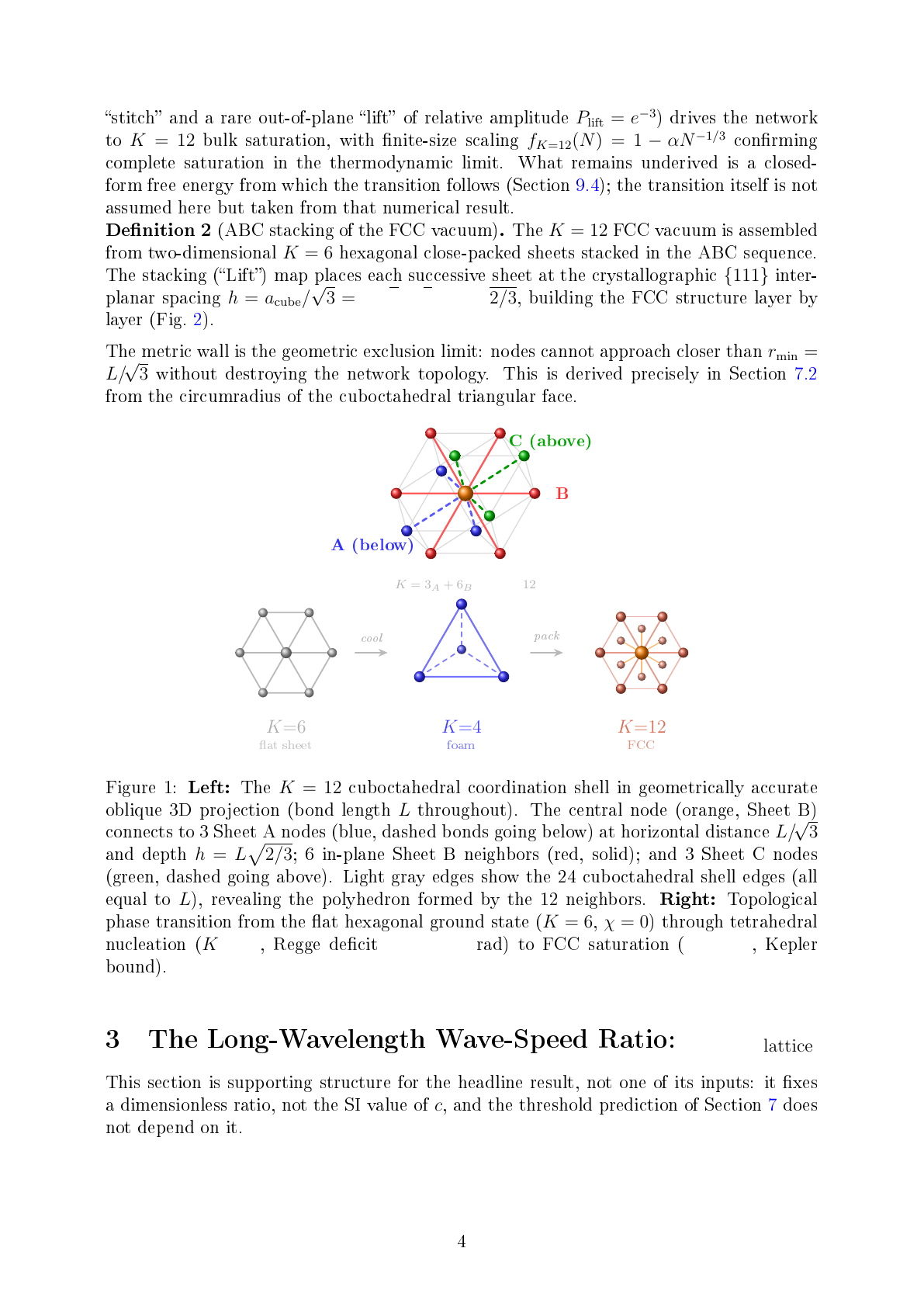
A (below)
B
C (above)
K = 3
A
+ 6
B
+ 3
C
= 12
K=6
at sheet
cool
K=4
foam
pack
K=12
FCC
Figure 1:
Left:
The
K = 12
cuboctahedral coordination shell in geometrically accurate
oblique 3D projection (bond length
L
throughout). The central node (orange, Sheet B)
connects to 3 Sheet A nodes (blue, dashed bonds going below) at horizontal distance
L/
√
3
and depth
h = L
p
2/3
; 6 in-plane Sheet B neighbors (red, solid); and 3 Sheet C nodes
(green, dashed going above). Light gray edges show the 24 cuboctahedral shell edges (all
equal to
L
), revealing the polyhedron formed by the 12 neighbors.
Right:
Topological
phase transition from the at hexagonal ground state (
K = 6
,
χ = 0
) through tetrahedral
nucleation (
K = 4
, Regge decit
δ ≃ 0.128
rad) to FCC saturation (
K = 12
, Kepler
bound).
3 The Long-Wavelength Wave-Speed Ratio:
c = 4 v
lattice
This section is supporting structure for the headline result, not one of its inputs: it xes
a dimensionless ratio, not the SI value of
c
, and the threshold prediction of Section 7 does
not depend on it.
4
3.1 The FCC structure tensor
The 12 FCC unit bond vectors are
ˆn
j
∈
1
√
2
{(±1, ±1, 0), (±1, 0, ±1), (0, ±1, ±1)}, j = 1, . . . , 12.
(1)
The second-rank structure tensor
S
µν
=
P
j
ˆn
µ
j
ˆn
ν
j
is computed directly:
S
xx
=
12
X
j=1
(ˆn
x
j
)
2
= 4 ×
1
2
+ 4 ×
1
2
= 4,
(2)
S
xy
=
12
X
j=1
ˆn
x
j
ˆn
y
j
= 0
(by cubic symmetry). (3)
Therefore:
S
µν
= 4 δ
µν
.
(4)
This result is more transparent than it rst appears. For any set of
K
unit bond vectors
whose second moment is isotropic,
tr S =
P
j
|ˆn
j
|
2
= K
distributes equally over the
d
spatial directions, so
S
µν
=
K
d
δ
µν
,
(5)
and the eigenvalue is simply the coordination-to-dimension ratio
K/d
. The value
4
is
therefore
12/3
, xed by the
K = 12
kissing number in
d = 3
; the same formula gives BCC
(
8/3
) and simple cubic (
2
). We do not claim
4
is a free-standing constant of the FCC
lattice it is the kissing number divided by the spatial dimension, and the FCC value
follows entirely from
K = 12
. What is specic to FCC is that
K = 12
is the maximal
(Kepler-saturating) coordination in
d = 3
[3], so
4
is the largest such ratio any
3
D Bravais
lattice can realize.
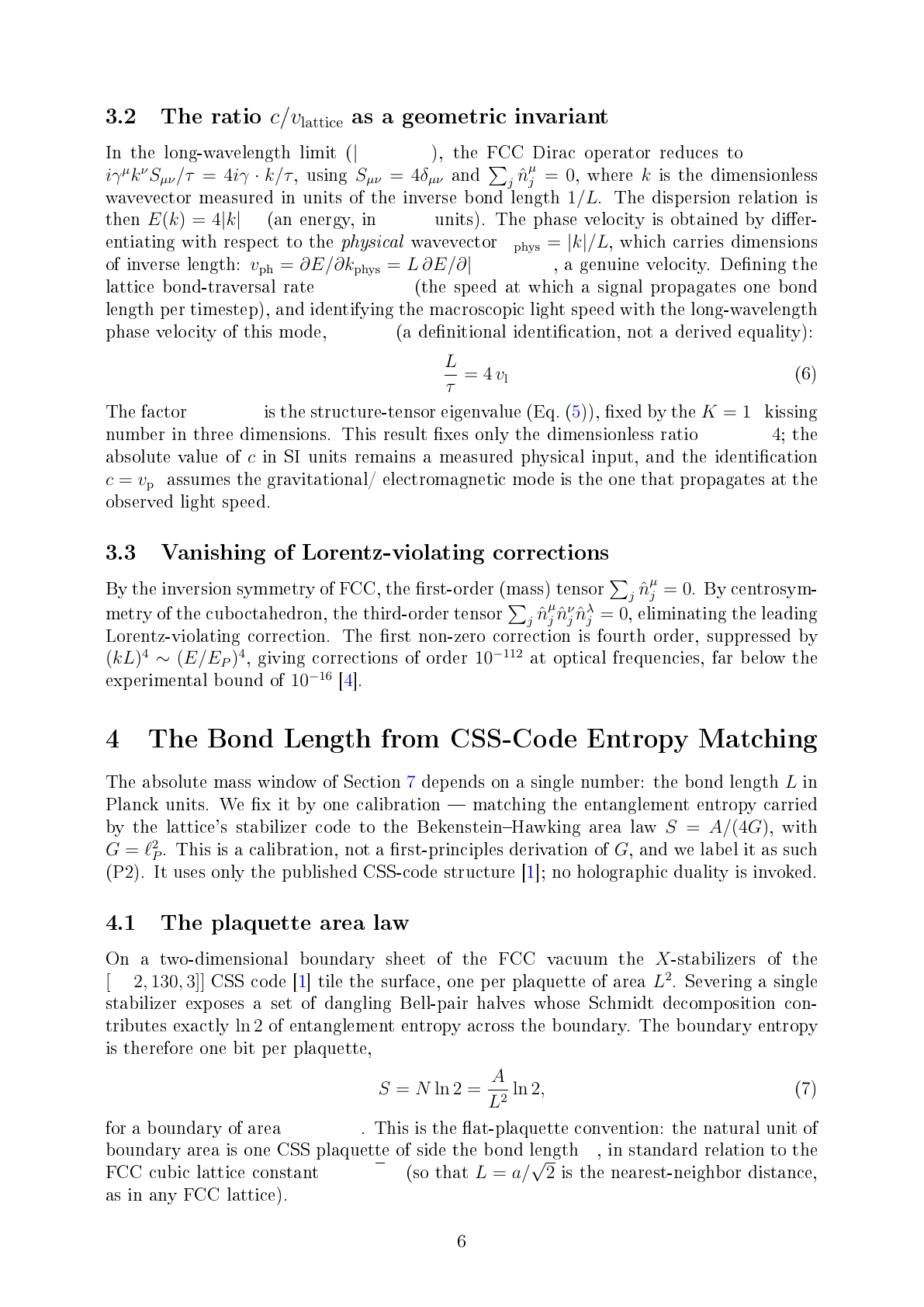
Sheet A
z = 0
Sheet B
z = h
Sheet C
z = 2h
h = L
q
2
3
Figure 2: ABC stacking of
K = 6
hexagonal sheets in geometrically accurate oblique 3D.
Sheet A (blue,
z = 0
), Sheet B (red,
z = h
), Sheet C (green,
z = 2h
), each shifted to
inequivalent hex sites (B laterally oset by
r
min
= L/
√
3
from its 3 nearest A-nodes and 3
nearest C-nodes, whose full 3D bond distance is
L
). The orange atom is the central B node;
colored bonds show its
K = 12
coordination: 3 blue bonds to Sheet A (length
L
, oblique), 6
red bonds to Sheet B neighbors (length
L
, in-plane), and 3 green bonds to Sheet C (length
L
, oblique). Light gray edges connect the 12 neighbors to each other, tracing the 24 edges
of the cuboctahedron that emerges from the stacking. Interlayer spacing
h = L
p
2/3
is
the crystallographic
{111}
interplanar distance.
5
3.2 The ratio
c/v
lattice
as a geometric invariant
In the long-wavelength limit (
|k|L ≪ 1
), the FCC Dirac operator reduces to
D
SSM
≈
iγ
µ
k
ν
S
µν
/τ = 4iγ · k/τ
, using
S
µν
= 4δ
µν
and
P
j
ˆn
µ
j
= 0
, where
k
is the dimensionless
wavevector measured in units of the inverse bond length
1/L
. The dispersion relation is
then
E(k) = 4|k|/τ
(an energy, in
ℏ = 1
units). The phase velocity is obtained by dier-
entiating with respect to the
physical
wavevector
k
phys
= |k|/L
, which carries dimensions
of inverse length:
v
ph
= ∂E/∂k
phys
= L ∂E/∂|k| = 4L/τ
, a genuine velocity. Dening the
lattice bond-traversal rate
v
lat
≡ L/τ
(the speed at which a signal propagates one bond
length per timestep), and identifying the macroscopic light speed with the long-wavelength
phase velocity of this mode,
c ≡ v
ph
(a denitional identication, not a derived equality):
c = 4
L
τ
= 4 v
lat
.
(6)
The factor
4 = K/d
is the structure-tensor eigenvalue (Eq. (5)), xed by the
K = 12
kissing
number in three dimensions. This result xes only the dimensionless ratio
c/v
lat
= 4
; the
absolute value of
c
in SI units remains a measured physical input, and the identication
c = v
ph
assumes the gravitational/ electromagnetic mode is the one that propagates at the
observed light speed.
3.3 Vanishing of Lorentz-violating corrections
By the inversion symmetry of FCC, the rst-order (mass) tensor
P
j
ˆn
µ
j
= 0
. By centrosym-
metry of the cuboctahedron, the third-order tensor
P
j
ˆn
µ
j
ˆn
ν
j
ˆn
λ
j
= 0
, eliminating the leading
Lorentz-violating correction. The rst non-zero correction is fourth order, suppressed by
(kL)
4
∼ (E/E
P
)
4
, giving corrections of order
10
−112
at optical frequencies, far below the
experimental bound of
10
−16
[4].
4 The Bond Length from CSS-Code Entropy Matching
The absolute mass window of Section 7 depends on a single number: the bond length
L
in
Planck units. We x it by one calibration matching the entanglement entropy carried
by the lattice's stabilizer code to the BekensteinHawking area law
S = A/(4G)
, with
G = ℓ
2
P
. This is a calibration, not a rst-principles derivation of
G
, and we label it as such
(P2). It uses only the published CSS-code structure [1]; no holographic duality is invoked.
4.1 The plaquette area law
On a two-dimensional boundary sheet of the FCC vacuum the
X
-stabilizers of the
[[192, 130, 3]]
CSS code [1] tile the surface, one per plaquette of area
L
2
. Severing a single
stabilizer exposes a set of dangling Bell-pair halves whose Schmidt decomposition con-
tributes exactly
ln 2
of entanglement entropy across the boundary. The boundary entropy
is therefore one bit per plaquette,
S = N ln 2 =
A
L
2
ln 2,
(7)
for a boundary of area
A = NL
2
. This is the at-plaquette convention: the natural unit of
boundary area is one CSS plaquette of side the bond length
L
, in standard relation to the
FCC cubic lattice constant
a =
√
2 L
(so that
L = a/
√
2
is the nearest-neighbor distance,
as in any FCC lattice).
6
4.2 Matching to the area law xes
L
Identifying Eq. (7) with the BekensteinHawking entropy
S = A/(4G)
at the single-
plaquette level gives
ln 2
L
2
=
1
4G
=⇒ G =
L
2
4 ln 2
.
(8)
Setting
G = ℓ
2
P
xes the bond length:
L =
√
4 ln 2 ℓ
P
≃ 1.665 ℓ
P
.
(9)
Equivalently
L
2
= 4ℓ
2
P
ln 2
: the bond length squared is four times the Planck area, weighted
by the
ln 2
(one bit) of entanglement each Bell-pair bond carries. The
ln 2
is intrinsic to
the model every bond is a single Bell pair so the calibration ties
L
to
ℓ
P
through the
bond's own entropy, with no geometric convention factor beyond the plaquette area itself.
We do not derive
G
; we use the standard area law as the single calibration that xes
L
,
citing only the published stabilizer structure [1].
Consistency check (energy density).
An independent upper bound on the lattice
energy density conrms the scale. Each node transmits at most one quantum per timestep
τ = 4L/c
, giving a maximum energy density
ρ
lattice
=
√
2 ℏc/(4L
4
)
over the FCC volume per
node
V
node
= L
3
√
2/2
. Requiring
ρ
lattice
≤ ρ
P
= ℏc/ℓ
4
P
gives
L ≥ (
√
2/4)
1/4
ℓ
P
≃ 0.77 ℓ
P
,
which
L = 1.665 ℓ
P
satises comfortably. The energy-density bound xes the scale; the
area-law calibration supplies the value.
4.3 Summary of FCC length scales
Scale Value Geometric origin
Bond length
L =
√
4 ln 2 ℓ
P
= 1.665 ℓ
P
CSS plaquette area law
Lattice constant
a =
√
2 L = 2.355 ℓ
P
FCC cubic cell edge
Interlayer spacing
h = L
p
2/3 = 1.360 ℓ
P
a/
√
3
,
{111}
planes
Metric wall
r
min
= L/
√
3 = 0.961 ℓ
P
Circumradius of triangular face
5 Emergent Lorentz Invariance
Emergent SO(3,1) Lorentz invariance of the
K = 12
FCC vacuum follows from the structure
tensor identity
S
µν
= 4δ
µν
(Eq. (4)), proven in Section 3. We summarize the argument
here.
From
S
µν
= 4δ
µν
to emergent SO(3).
The FCC bond vectors (Eq. (1)) satisfy two
tensor identities, both established in Section 3 (and independently in [2]): the rank-2
structure tensor
S
µν
= 4δ
µν
(second-order spatial isotropy) and the rank-3 tensor
T
µνλ
=
P
j
ˆn
µ
j
ˆn
ν
j
ˆn
λ
j
= 0
(centrosymmetry, eliminating all preferred-direction terms at third order).
Together these force the long-wavelength dispersion relation to be isotropic to all orders
below
O((kL)
4
)
:
E(k) = 4|k|/τ
, with no
O(k)
or
O(k
3
)
corrections.
From SO(3) to SO(3,1).
The hexagonal
K = 6
close-packed sheets carry exact contin-
uous SO(2) rotational symmetry. Four families of
{111}
close-packed planes project this
into three independent spatial directions via the ABC stacking map, generating SO(3).
Assuming all low-energy Cosserat modes share a single propagation speed
c
(an input of
the construction, not a derived consequence dierent modes could in principle propagate
7
at dierent speeds), SO(3) spatial isotropy plus time-reversal symmetry plus a single speed
uniquely determine the Lorentz-invariant dispersion form for all dimension-
≤ 4
operators,
by the standard continuum-limit argument. Lorentz invariance therefore emerges in the
long-wavelength limit, with violations suppressed by
(kL)
4
. Residual Lorentz violation
enters only at fourth order in
(kL)
, suppressed by
(E/E
P
)
4
∼ 10
−112
at optical frequencies
far below the experimental bound of
10
−16
[4].
6 Schrödinger Equation as Cosserat Continuum Limit
This section is supporting motivation for quantum kinematics on the lattice, not a core
result of the paper. It is conditional on the chiral coupling (P5), which we do not derive,
and the threshold prediction of Section 7 does not rely on it.
6.1 The chiral Cosserat Lagrangian
Each lattice node carries a translational displacement
u
and a microrotation
θ
, the two
independent elds of a three-dimensional Cosserat continuum [8] (three components each).
The bond decomposition
K = S
trans
+ S
tors
= 4 + 8
refers to the two
bond subsets
that
source these elds the 4 tetrahedral bonds feeding the translational sector and the 8
remaining bonds feeding the rotational (torsional) sector and is not a count of continuum
degrees of freedom, which remain
3+3
. We treat
u
and
θ
below as the coarse-grained scalar
amplitudes of these two sectors. The Lagrangian density for a topological braid threading
the lattice is:
L =
1
2
(∂
t
u)
2
+
1
2
(∂
t
θ)
2
−
c
2
2
(∇u)
2
−
c
2
2
(∇θ)
2
−
ω
2
0
2
(u
2
+ θ
2
) + Ω( ˙uθ −
˙
θu).
(10)
The chiral coupling
Ω( ˙uθ −
˙
θu)
is
conjectured
to arise from the Berry connection of the
discrete lattice wavefunction; a derivation of
Ω
from the
K = 12
bond geometry has not
been carried out (see 9.4).
6.2 Structural isomorphism with the Schrödinger equation
The Euler-Lagrange equations are:
¨u − c
2
∇
2
u + ω
2
0
u + 2Ω
˙
θ = 0,
(11)
¨
θ − c
2
∇
2
θ + ω
2
0
θ − 2Ω ˙u = 0.
(12)
Dening
ψ = u + iθ
and multiplying Eq. (12) by
i
and adding:
∂
2
ψ
∂t
2
− 2iΩ
∂ψ
∂t
− c
2
∇
2
ψ + ω
2
0
ψ = 0.
(13)
Within this construction the complex unit
i
plays the role of the operator pairing trans-
lational and rotational modes of the Cosserat lattice: it is introduced as the bookkeeping
combination
ψ = u+iθ
of two real elds, and acquires this geometric reading only once the
chiral coupling
Ω
is present. We do not claim
i
emerges independently of that coupling,
which is itself conjectural (9.4). In the non-relativistic limit the envelope evolves slowly
on the scale of
Ω
, so
∂
2
t
ψ
is negligible against
2Ω ∂
t
ψ
; absorbing the constant energy oset
ℏω
2
0
/(2Ω)
by the Larmor-frame substitution
ψ = Φ e
−iω
2
0
t/(2Ω)
then yields:
iℏ
∂Φ
∂t
= −
ℏ
2
2m
∇
2
Φ.
(14)
8
On the role of
ℏ
.
The Cosserat framework is a classical continuum theory: it does
not intrinsically contain action quantization. The factor
ℏ
enters as follows. Each FCC
bond transmits at most one quantum per timestep
τ = 4L/c
(from
c = 4v
lat
= 4L/τ
,
Section 3). The natural energy quantum of the lattice is therefore
ε = ℏ/τ = ℏc/(4L)
,
setting the Planck-scale bond energy scale. The non-relativistic reduction of the wave
equation (13) takes Schrödinger form when
Ω = mc
2
/ℏ
, i.e., when the rest energy
mc
2
equals
ℏΩ ∼ ℏc/L
the bond energy scale. This identication is consistent with the
soft threshold
m
soft
= ℏ/(Lc)
(Section 7), where the same scale reappears as the onset
of lattice corrections. The content of this section is therefore a
structural isomorphism
:
the long-wavelength continuum limit of the
K = 12
Cosserat lattice takes the form of the
free-particle Schrödinger equation once the chiral coupling is present. This is a non-trivial
result once the chiral coupling is present, its
form
(a translationrotation cross term)
is the generic Cosserat invariant and the value
Ω = mc
2
/ℏ
and the Larmor frame are then
xed by the reduction rather than inserted by hand but it is an isomorphism, not an
ab
initio
derivation of
ℏ
from geometry alone, and the microscopic origin of
Ω
(its sign and
magnitude from the
K = 12
Berry connection) remains conjectural (9.4).
7 The Two-Step Quantum-Classical Threshold
Two mass scales emerge from the
K = 12
cuboctahedral unit cell. Before developing them,
we separate what is robust from what is conjectural. The robust content is geometric: the
bond length
L = 1.665 ℓ
P
(xed by P2), the face circumradius
L/
√
3
, and the exact ratio
√
3
between them. The conjectural content is the representability hypothesis: that these
lengths govern whether a center-of-mass excitation remains coherently representable on the
lattice, through its reduced Compton scale (P3). The
√
3
ratio survives even if the absolute
scale is wrong; the mass-window values and their identication with a quantum-classical
boundary do not survive without P2 and P3. We ag this split here and return to it in the
central-hypothesis paragraph below.
Both scales are xed by
L = 1.665 ℓ
P
(Section 4) and the exact geometry of the
cuboctahedral faces, with no tted parameters. We dene them purely geometrically:
m
soft
= ℏ/(Lc)
is the mass at which the reduced Compton length
λ
c
= ℏ/(mc)
equals
L
, and
m
hard
= ℏ
√
3/(Lc)
is the mass at which
λ
c
equals the triangular face circumra-
dius
L/
√
3
. The reduced Compton length
λ
c
is the scale associated with the rest energy
mc
2
= ℏc/λ
c
; it is
not
the spatial extent of the center-of-mass wavefunction in any experi-
ment, which is set by trap frequencies and is many orders of magnitude larger.
Both thresholds are of order the Planck mass. Since
m
soft
= ℏ/(Lc) = m
P
/(L/ℓ
P
) =
m
P
/1.665
and
m
hard
=
√
3 m
soft
= 1.04 m
P
, with
m
P
=
p
ℏc/G ≈ 21.8 µ
g, the scale itself
is
not
a novel prediction: the DiósiPenrose gravitational-collapse scale is likewise
O(m
P
)
.
What is specic to the SSM, and what makes the prediction falsiable, is the
structure
of the boundary two thresholds rather than one, separated by the exact, parameter-
free ratio
m
hard
/m
soft
=
√
3
(the edge-to-circumradius ratio of the triangular face), with a
concave-up prole in between a quadratic onset
Γ ∝ (m −m
soft
)
2
at
m
soft
that steepens
to
Γ ∝ [(m/m
soft
)
2
− 1]
2
approaching
m
hard
. The remainder of this section develops this
structure and contrasts it with the single smooth threshold of DiósiPenrose.
Physical interpretation (conjectured).
The SSM proposes that the lower geometric
scale marks the onset of a reversible dispersive deformation of a center-of-mass excitation of
mass
m
, and the upper scale the point at which it can no longer be coherently represented
9
on the lattice. The reasoning is as follows: the Cosserat lattice dispersion (Eq. (16)) carries
a correction
(kL)
2
. When this correction is evaluated at the wavenumber
k
c
= mc/ℏ
the
reduced Compton scale, the intrinsic rest-energy wavevector of the excitation it becomes
(m/m
soft
)
2
. The conjecture is that as this ratio crosses unity the excitation ceases to be
cleanly representable: a reversible deformation sets in, growing until representability fails
outright at the hard threshold. We emphasize that
this is a conjecture, not a derivation
: a
rst-principles treatment would have to derive the representability bound from the lattice
response itself the long-wavelength Green's function of the
K = 12
network evaluated at
the rest-energy scale which we do not do here. We treat Eq. (20) as a phenomenological
rate law motivated by the lattice geometry.
The central hypothesis: Compton representability.
The weakest step in this chain is
the choice of length scale, and we state it plainly. Because the lattice
is
the vacuum rather
than an environment external to the object, the relevant question is not how a center-of-
mass superposition couples to a bath. That would be an ordinary decoherence process, and
such processes are governed by the spatial
delocalization
∆x
between branches, which is set
by trap geometry and is orders of magnitude larger than any lattice scale. The question is
instead whether each branch, on its own, is coherently representable as a lattice excitation
and that single-branch question carries no
∆x
: branch separation says how far apart
two independently-representable copies are placed, not whether either is representable. We
posit that representability is controlled by the
reduced Compton wavelength
λ
c
= ℏ/(mc)
,
the intrinsic rest-energy wavelength of the excitation, and fails once
λ
c
is no longer resolv-
able by the FCC geometry: the soft threshold at
λ
c
= L
, the hard threshold at
λ
c
= L/
√
3
.
This is a hypothesis, not a theorem; it treats the macroscopic center-of-mass mode as a
single excitation characterized by its total rest energy, and it is what an experiment in the
13.1
22.6 µ
g window would test. We do not derive it, and the falsiable content (the
√
3
ratio and the two-step prole) stands or falls with it. Its distinctive, testable signature
is precisely the
absence
of
∆x
-dependence that an environmental-coupling model would
predict. The next subsection collects the physical motivations for this choice of scale and
addresses the natural objections to it.
7.1 Why the Compton scale and not the trap scale
The natural objection to P3 is best stated at once. In standard quantum mechanics
the spatial extent of a center-of-mass wavefunction is set by external potentials trap
frequencies and not by the Compton wavelength; the rest mass of a
10 µ
g object certainly
does not conne its wavepacket to a Planck-scale packet. If P3 claimed spatial pinching, it
would simply be wrong. It does not. Four observations locate the actual physical content
of the hypothesis; we present them as motivations, not derivations.
(i) The mass term is a clock, not a packet width.
Any excitation of mass
m
whatever its spatial envelope carries a rest-energy phase evolving at the Compton
frequency
Ω = mc
2
/ℏ
. This internal clock is standard quantum mechanics: it is the de
Broglie phase of the massive state, and interferometry has been performed directly against
it [10]. On the lattice, the update interval is
τ = 4L/c
(Section 3), so the dimensionless
product is
Ωτ = 4 (m/m
soft
)
: the soft threshold is the mass at which the center-of-mass
mode's phase clock reaches the lattice's temporal bandwidth (
Ωτ = 4
), and the hard
threshold corresponds to
Ωτ = 4
√
3
. A discrete network cannot faithfully track a phase
rotating faster than its refresh rate, in direct analogy with sampling above the Nyquist
limit. The reduced Compton wavelength enters as
c/Ω
the spatial period of this phase
10
pattern not as a claim about wavefunction extent, which remains trap-dominated and
macroscopic. We use the bandwidth argument to x the
scale
, not the coecient: a naive
Nyquist criterion (
Ωτ = π
) would place the breakdown at
λ
c
= 4L/π ≈ 1.27 L
rather than
exactly
L
. The precise endpoints of the window remain anchored to the geometry the
bond length and the face circumradius with the bandwidth argument supplying the
physical reason a threshold of this order must exist at all.
(ii) The lattice-eld-theory precedent.
In any lattice-regularized eld theory, a eld
of mass
m
supports a coherent propagating quasiparticle only while its correlation length
ξ = λ
c
exceeds the lattice spacing; once the bare mass in lattice units exceeds unity, the
excitation localizes to a single site and drops out of the eective theory [11]. P3 asserts
that the vacuum lattice behaves like every other lattice regulator: it carries a genuine mass
cuto at
λ
c
∼ L
. What is hypothesized is not this mechanism, which is standard, but its
application to the collective center-of-mass mode point (iii).
(iii) The composite-object question.
A
13 µ
g object contains
∼10
19
atoms; why should
the
total
mass, rather than the constituent masses, govern anything? Standard quantum
mechanics already answers half of this: the center of mass of a composite is a canonical
degree of freedom of total mass
M
, and experiment conrms that the total mass is what
enters center-of-mass coherence molecular interferometry observes the de Broglie wave-
length
h/(Mv)
with the full molecular mass beyond 25 kDa [12], and the Bild cat state is a
superposition of a single collective mode of eective mass
16.2 µ
g [6]. P3 extends this one
step: the vacuum lattice, too, addresses the center-of-mass mode at its total
M
. A physical
rationale though not a derivation is that the lattice is the substrate of geometry, and
geometry couples to total stress-energy; this is also why the threshold lands at the Planck
mass, for the same reason the DiósiPenrose scale does.
(iv) Objects above the cuto.
Masses far above
m
hard
manifestly exist. The hard cuto
forbids only the coherent
single-mode
center-of-mass superposition: above
m
hard
the object
persists as a multi-mode lattice conguration whose constituent modes are individually far
below cuto but whose relative phases are unprotected that is, it exists and behaves
classically. This is not a failure of the model; it is the model reproducing the observed
classical world above the window.
The irreducible content of P3 is the coupling assumption in (iii): that the FCC network
addresses the collective mode at total
M
rather than constituent-by-constituent. Points
(i), (ii), and (iv) motivate the scale and answer the objections above; none of them derives
that coupling. The hypothesis therefore remains what we have called it the paper's chief
vulnerability but it is a hypothesis with independent physical motivations and a clean
experimental discriminator (the
∆x
-independent mass scan set out in the DiósiPenrose
comparison at the end of this section), not an arbitrary choice of length scale.
7.2 The metric wall from cuboctahedral face geometry
The
K = 12
unit cell is a cuboctahedron with 8 equilateral triangular faces of edge length
L
, established in Section 2. Every triangular face has a circumscribed circle of radius
r
min
=
L
√
3
,
(15)
the distance from the face center to each of its three vertices. This is the circumradius
formula for an equilateral triangle with side
a
:
R = a/
√
3
, applied with
a = L
. (Note:
11
the insphere radius of a regular tetrahedron with edge
L
is
L/(2
√
6) ≈ 0.204L
, which is
dierent; the relevant scale here is the circumradius of the triangular
face
, not a void.)
The physical meaning is direct. A probe at the centroid of a triangular face with Compton
wavelength
λ
c
= ℏ/(mc)
shrinking to
r
min
simultaneously resolves all three face vertices at
exactly bond-length separation. Further compression would require
λ
c
< L/
√
3
: the probe
would have to t between nodes separated by
L
, which is the minimum bond length of the
network. The lattice topology forbids it this is the metric wall.
This length scale is not only analytic. The companion simulation [2] sweeps the exclusion
radius
R
ex
of the growing network and nds a sharp geometric phase transition at
R
ex
=
L/
√
3 ≃ 0.577 L
, with a wide
K = 12
stability plateau over
R
ex
∈ [0.58, 0.99] L
. Below
L/
√
3
the exclusion is too weak and unphysical overlaps (
K
max
> 12
) appear; the transition
therefore conrms, numerically, that
L/
√
3
is the operative minimum-approach distance
and not a tuned parameter. The two thresholds derived in Sections 7.37.4 inherit this
scale directly.
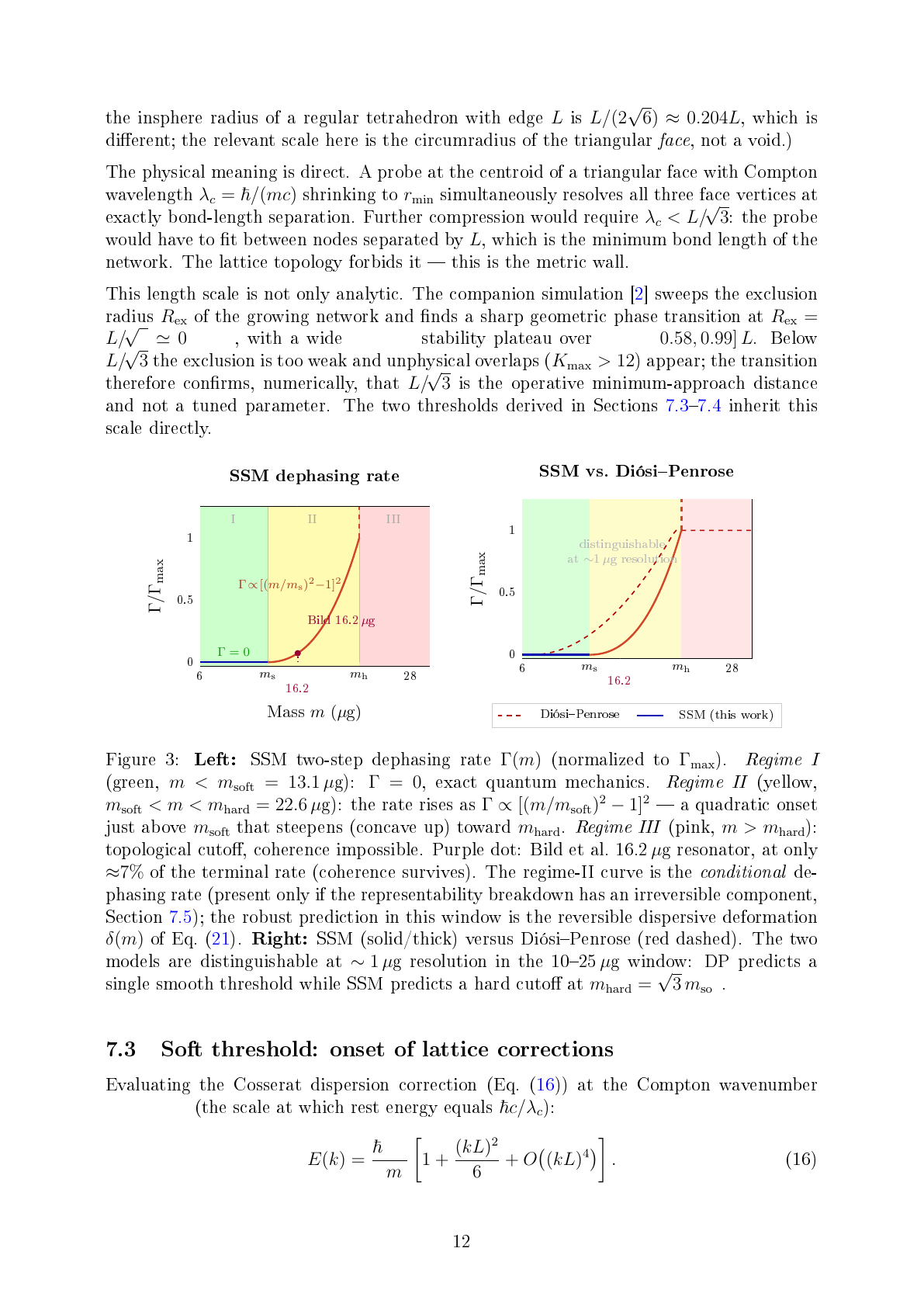
6
m
s
m
h
28
0
0.5
1
16.2
I II III
Bild 16.2
µ
g
Γ = 0
Γ∝ [(m/m
s
)
2
−1]
2
Mass
m
(
µ
g)
Γ/Γ
max
SSM dephasing rate
6
m
s
m
h
28
0
0.5
1
16.2
distinguishable
at
∼
1
µ
g resolution
Γ/Γ
max
SSM vs. DiósiPenrose
DiósiPenrose
SSM (this work)
Figure 3:
Left:
SSM two-step dephasing rate
Γ(m)
(normalized to
Γ
max
).
Regime I
(green,
m < m
soft
= 13.1 µ
g):
Γ = 0
, exact quantum mechanics.
Regime II
(yellow,
m
soft
< m < m
hard
= 22.6 µ
g): the rate rises as
Γ ∝ [(m/m
soft
)
2
−1]
2
a quadratic onset
just above
m
soft
that steepens (concave up) toward
m
hard
.
Regime III
(pink,
m > m
hard
):
topological cuto, coherence impossible. Purple dot: Bild et al. 16.2
µ
g resonator, at only
≈7%
of the terminal rate (coherence survives). The regime-II curve is the
conditional
de-
phasing rate (present only if the representability breakdown has an irreversible component,
Section 7.5); the robust prediction in this window is the reversible dispersive deformation
δ(m)
of Eq. (21).
Right:
SSM (solid/thick) versus DiósiPenrose (red dashed). The two
models are distinguishable at
∼ 1 µ
g resolution in the 1025
µ
g window: DP predicts a
single smooth threshold while SSM predicts a hard cuto at
m
hard
=
√
3 m
soft
.
7.3 Soft threshold: onset of lattice corrections
Evaluating the Cosserat dispersion correction (Eq. (16)) at the Compton wavenumber
k
c
= mc/ℏ
(the scale at which rest energy equals
ℏc/λ
c
):
E(k) =
ℏ
2
k
2
2m
1 +
(kL)
2
6
+ O
(kL)
4
.
(16)
12
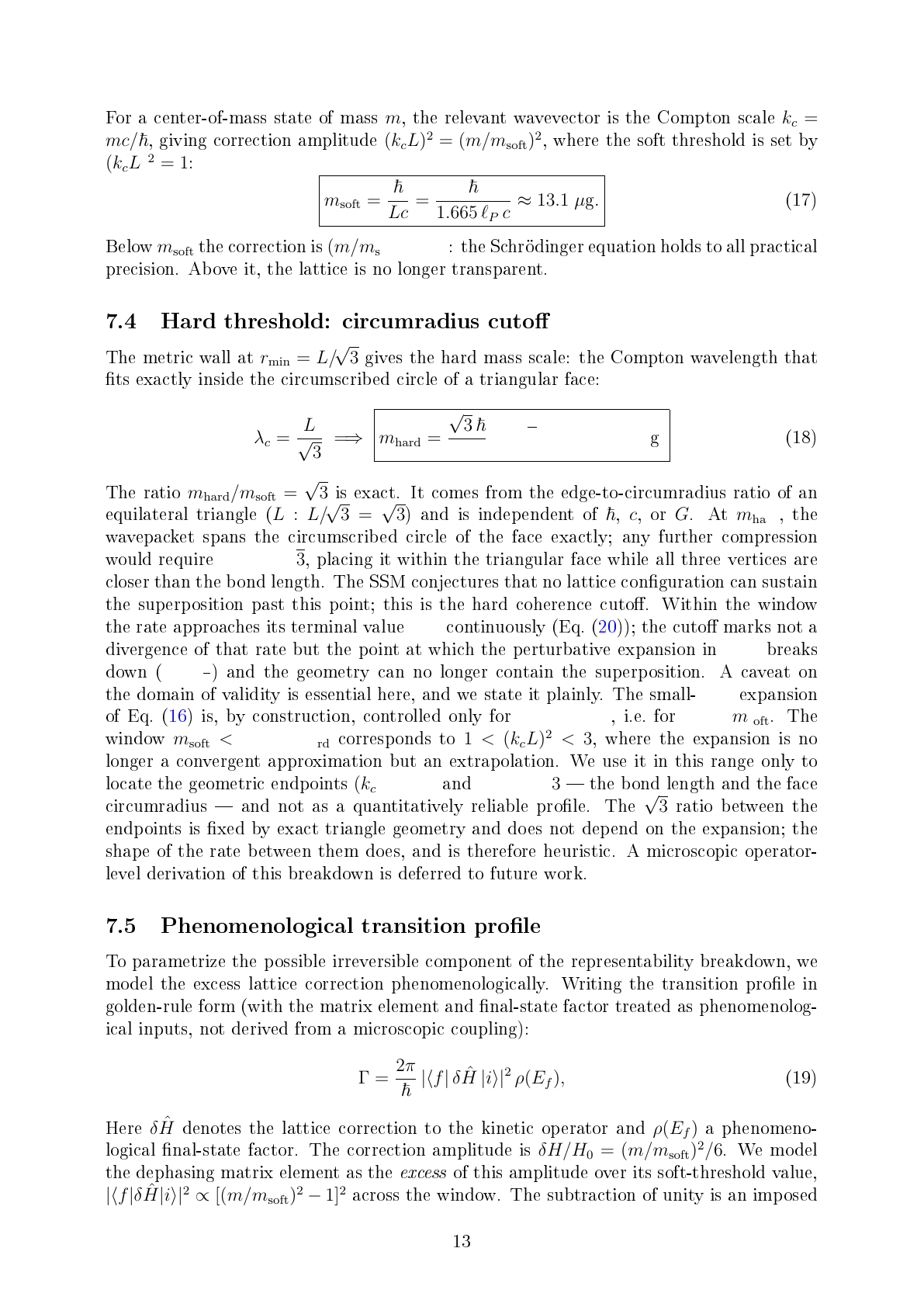
For a center-of-mass state of mass
m
, the relevant wavevector is the Compton scale
k
c
=
mc/ℏ
, giving correction amplitude
(k
c
L)
2
= (m/m
soft
)
2
, where the soft threshold is set by
(k
c
L)
2
= 1
:
m
soft
=
ℏ
Lc
=
ℏ
1.665 ℓ
P
c
≈ 13.1 µ
g
.
(17)
Below
m
soft
the correction is
(m/m
soft
)
2
≪ 1
: the Schrödinger equation holds to all practical
precision. Above it, the lattice is no longer transparent.
7.4 Hard threshold: circumradius cuto
The metric wall at
r
min
= L/
√
3
gives the hard mass scale: the Compton wavelength that
ts exactly inside the circumscribed circle of a triangular face:
λ
c
=
L
√
3
=⇒ m
hard
=
√
3 ℏ
Lc
=
√
3 m
soft
≈ 22.6 µ
g
.
(18)
The ratio
m
hard
/m
soft
=
√
3
is exact. It comes from the edge-to-circumradius ratio of an
equilateral triangle (
L : L/
√
3 =
√
3
) and is independent of
ℏ
,
c
, or
G
. At
m
hard
, the
wavepacket spans the circumscribed circle of the face exactly; any further compression
would require
λ
c
< L/
√
3
, placing it within the triangular face while all three vertices are
closer than the bond length. The SSM conjectures that no lattice conguration can sustain
the superposition past this point; this is the hard coherence cuto. Within the window
the rate approaches its terminal value
4 Γ
0
continuously (Eq. (20)); the cuto marks not a
divergence of that rate but the point at which the perturbative expansion in
(kL)
breaks
down (
δ =
1
2
) and the geometry can no longer contain the superposition. A caveat on
the domain of validity is essential here, and we state it plainly. The small-
(kL)
expansion
of Eq. (16) is, by construction, controlled only for
(k
c
L)
2
≪ 1
, i.e. for
m ≪ m
soft
. The
window
m
soft
< m < m
hard
corresponds to
1 < (k
c
L)
2
< 3
, where the expansion is no
longer a convergent approximation but an extrapolation. We use it in this range only to
locate the geometric endpoints
(k
c
L)
2
= 1
and
(k
c
L)
2
= 3
the bond length and the face
circumradius and not as a quantitatively reliable prole. The
√
3
ratio between the
endpoints is xed by exact triangle geometry and does not depend on the expansion; the
shape of the rate between them does, and is therefore heuristic. A microscopic operator-
level derivation of this breakdown is deferred to future work.
7.5 Phenomenological transition prole
To parametrize the possible irreversible component of the representability breakdown, we
model the excess lattice correction phenomenologically. Writing the transition prole in
golden-rule form (with the matrix element and nal-state factor treated as phenomenolog-
ical inputs, not derived from a microscopic coupling):
Γ =
2π
ℏ
|⟨f|δ
ˆ
H |i⟩|
2
ρ(E
f
),
(19)
Here
δ
ˆ
H
denotes the lattice correction to the kinetic operator and
ρ(E
f
)
a phenomeno-
logical nal-state factor. The correction amplitude is
δH/H
0
= (m/m
soft
)
2
/6
. We model
the dephasing matrix element as the
excess
of this amplitude over its soft-threshold value,
|⟨f|δ
ˆ
H|i⟩|
2
∝ [(m/m
soft
)
2
−1]
2
across the window. The subtraction of unity is an imposed
13
modeling choice, not a consequence of the amplitude above: it enforces
Γ = 0
at
m
soft
so
that the rate switches on at the geometric threshold rather than below it. With
ρ(E
f
) ∝ m
slowly varying:
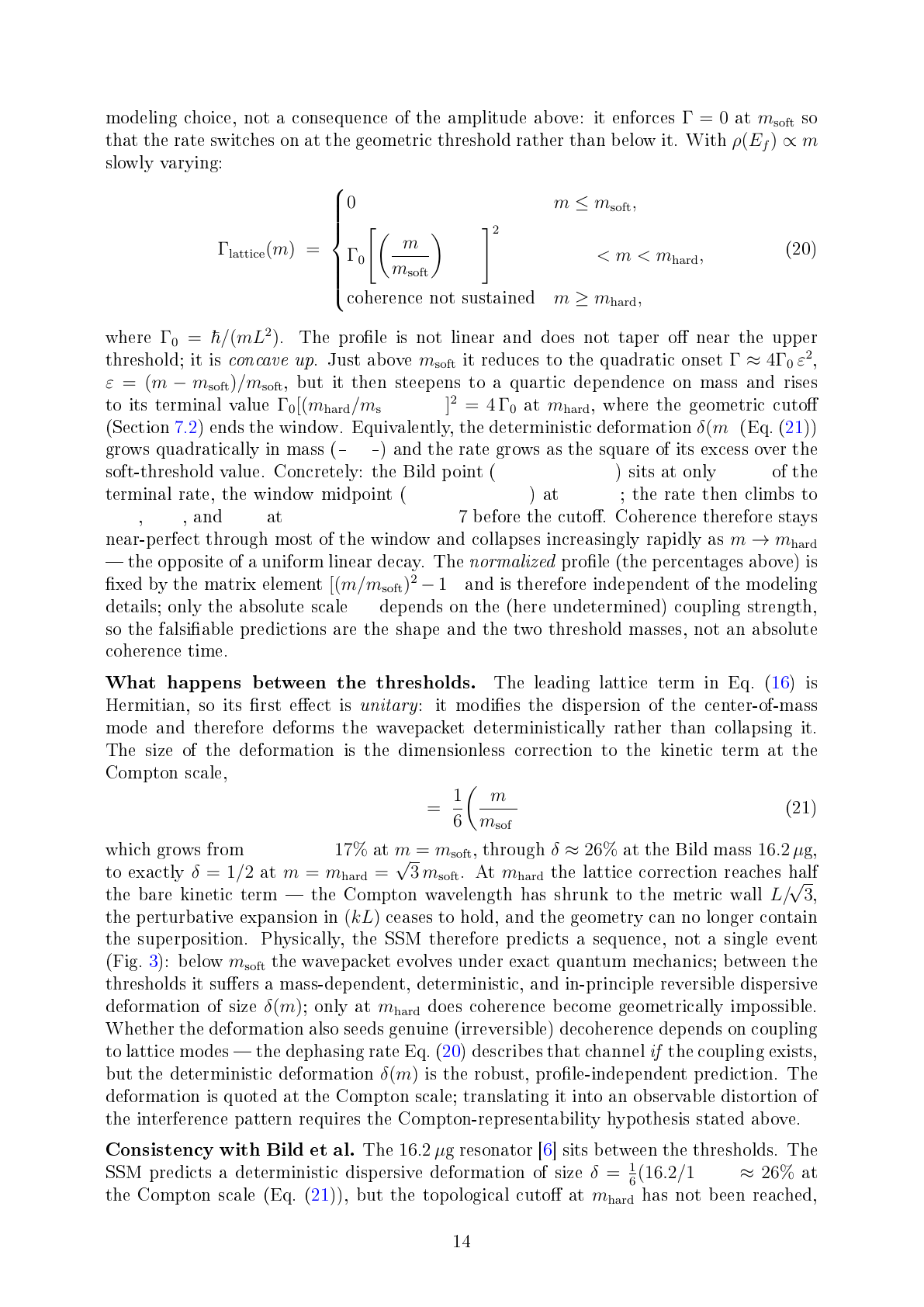
Γ
lattice
(m) =
0 m ≤ m
soft
,
Γ
0
"
m
m
soft
2
− 1
#
2
m
soft
< m < m
hard
,
coherence not sustained
m ≥ m
hard
,
(20)
where
Γ
0
= ℏ/(mL
2
)
. The prole is not linear and does not taper o near the upper
threshold; it is
concave up
. Just above
m
soft
it reduces to the quadratic onset
Γ ≈ 4Γ
0
ε
2
,
ε = (m − m
soft
)/m
soft
, but it then steepens to a quartic dependence on mass and rises
to its terminal value
Γ
0
[(m
hard
/m
soft
)
2
− 1]
2
= 4 Γ
0
at
m
hard
, where the geometric cuto
(Section 7.2) ends the window. Equivalently, the deterministic deformation
δ(m)
(Eq. (21))
grows quadratically in mass (
1
6
→
1
2
) and the rate grows as the square of its excess over the
soft-threshold value. Concretely: the Bild point (
m/m
soft
≈ 1.24
) sits at only
≈ 7%
of the
terminal rate, the window midpoint (
m/m
soft
≈ 1.37
) at
≈ 19%
; the rate then climbs to
39%
,
61%
, and
89%
at
m/m
soft
= 1.5, 1.6, 1.7
before the cuto. Coherence therefore stays
near-perfect through most of the window and collapses increasingly rapidly as
m → m
hard
the opposite of a uniform linear decay. The
normalized
prole (the percentages above) is
xed by the matrix element
[(m/m
soft
)
2
−1]
2
and is therefore independent of the modeling
details; only the absolute scale
Γ
0
depends on the (here undetermined) coupling strength,
so the falsiable predictions are the shape and the two threshold masses, not an absolute
coherence time.
What happens between the thresholds.
The leading lattice term in Eq. (16) is
Hermitian, so its rst eect is
unitary
: it modies the dispersion of the center-of-mass
mode and therefore deforms the wavepacket deterministically rather than collapsing it.
The size of the deformation is the dimensionless correction to the kinetic term at the
Compton scale,
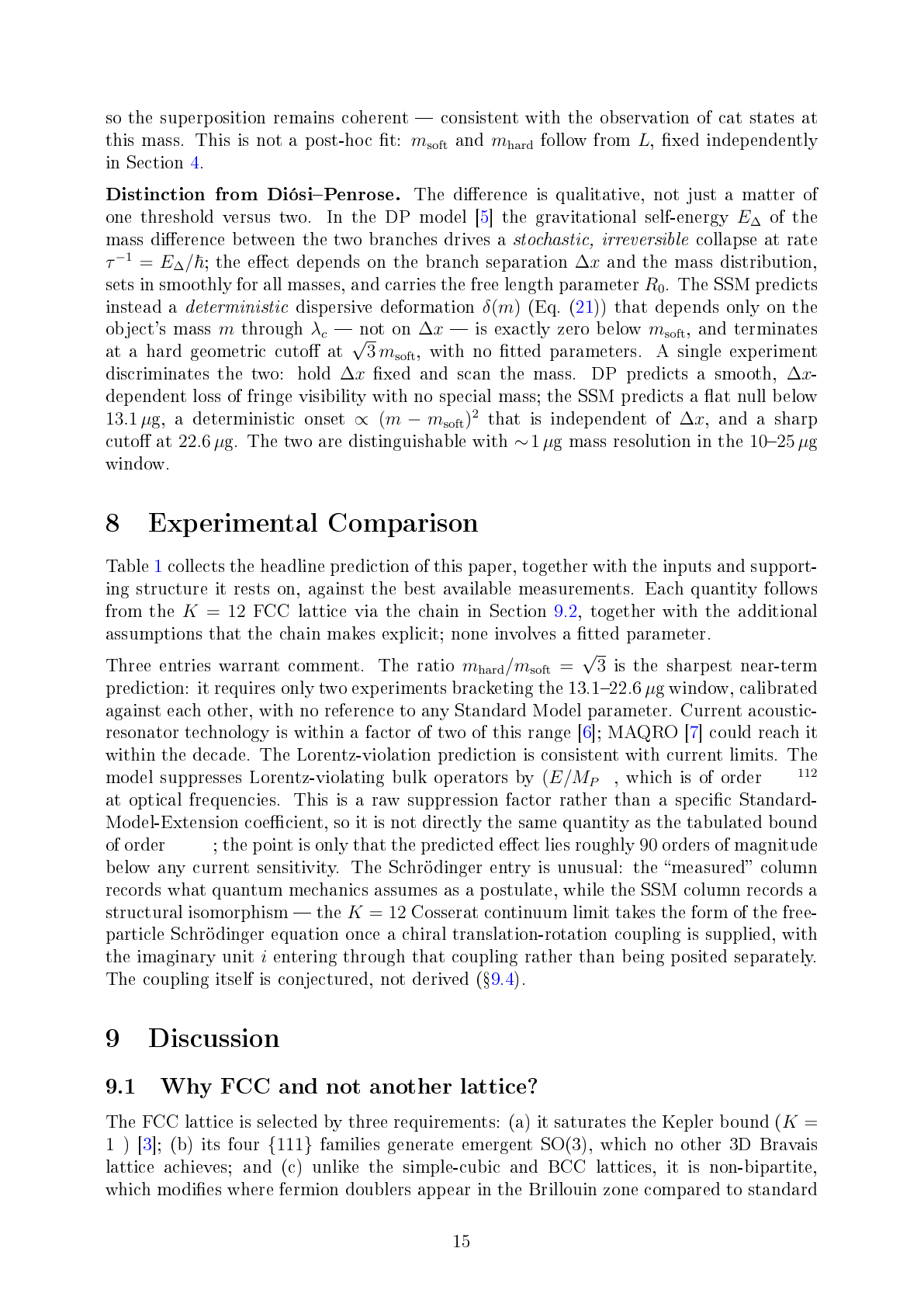
δ(m) =
1
6
m
m
soft
2
,
(21)
which grows from
δ = 1/6 ≈ 17%
at
m = m
soft
, through
δ ≈ 26%
at the Bild mass
16.2 µ
g,
to exactly
δ = 1/2
at
m = m
hard
=
√
3 m
soft
. At
m
hard
the lattice correction reaches half
the bare kinetic term the Compton wavelength has shrunk to the metric wall
L/
√
3
,
the perturbative expansion in
(kL)
ceases to hold, and the geometry can no longer contain
the superposition. Physically, the SSM therefore predicts a sequence, not a single event
(Fig. 3): below
m
soft
the wavepacket evolves under exact quantum mechanics; between the
thresholds it suers a mass-dependent, deterministic, and in-principle reversible dispersive
deformation of size
δ(m)
; only at
m
hard
does coherence become geometrically impossible.
Whether the deformation also seeds genuine (irreversible) decoherence depends on coupling
to lattice modes the dephasing rate Eq. (20) describes that channel
if
the coupling exists,
but the deterministic deformation
δ(m)
is the robust, prole-independent prediction. The
deformation is quoted at the Compton scale; translating it into an observable distortion of
the interference pattern requires the Compton-representability hypothesis stated above.
Consistency with Bild et al.
The 16.2
µ
g resonator [6] sits between the thresholds. The
SSM predicts a deterministic dispersive deformation of size
δ =
1
6
(16.2/13.1)
2
≈ 26%
at
the Compton scale (Eq. (21)), but the topological cuto at
m
hard
has not been reached,
14
so the superposition remains coherent consistent with the observation of cat states at
this mass. This is not a post-hoc t:
m
soft
and
m
hard
follow from
L
, xed independently
in Section 4.
Distinction from DiósiPenrose.
The dierence is qualitative, not just a matter of
one threshold versus two. In the DP model [5] the gravitational self-energy
E
∆
of the
mass dierence between the two branches drives a
stochastic, irreversible
collapse at rate
τ
−1
= E
∆
/ℏ
; the eect depends on the branch separation
∆x
and the mass distribution,
sets in smoothly for all masses, and carries the free length parameter
R
0
. The SSM predicts
instead a
deterministic
dispersive deformation
δ(m)
(Eq. (21)) that depends only on the
object's mass
m
through
λ
c
not on
∆x
is exactly zero below
m
soft
, and terminates
at a hard geometric cuto at
√
3 m
soft
, with no tted parameters. A single experiment
discriminates the two: hold
∆x
xed and scan the mass. DP predicts a smooth,
∆x
-
dependent loss of fringe visibility with no special mass; the SSM predicts a at null below
13.1 µ
g, a deterministic onset
∝ (m − m
soft
)
2
that is independent of
∆x
, and a sharp
cuto at
22.6 µ
g. The two are distinguishable with
∼1 µ
g mass resolution in the
10
25 µ
g
window.
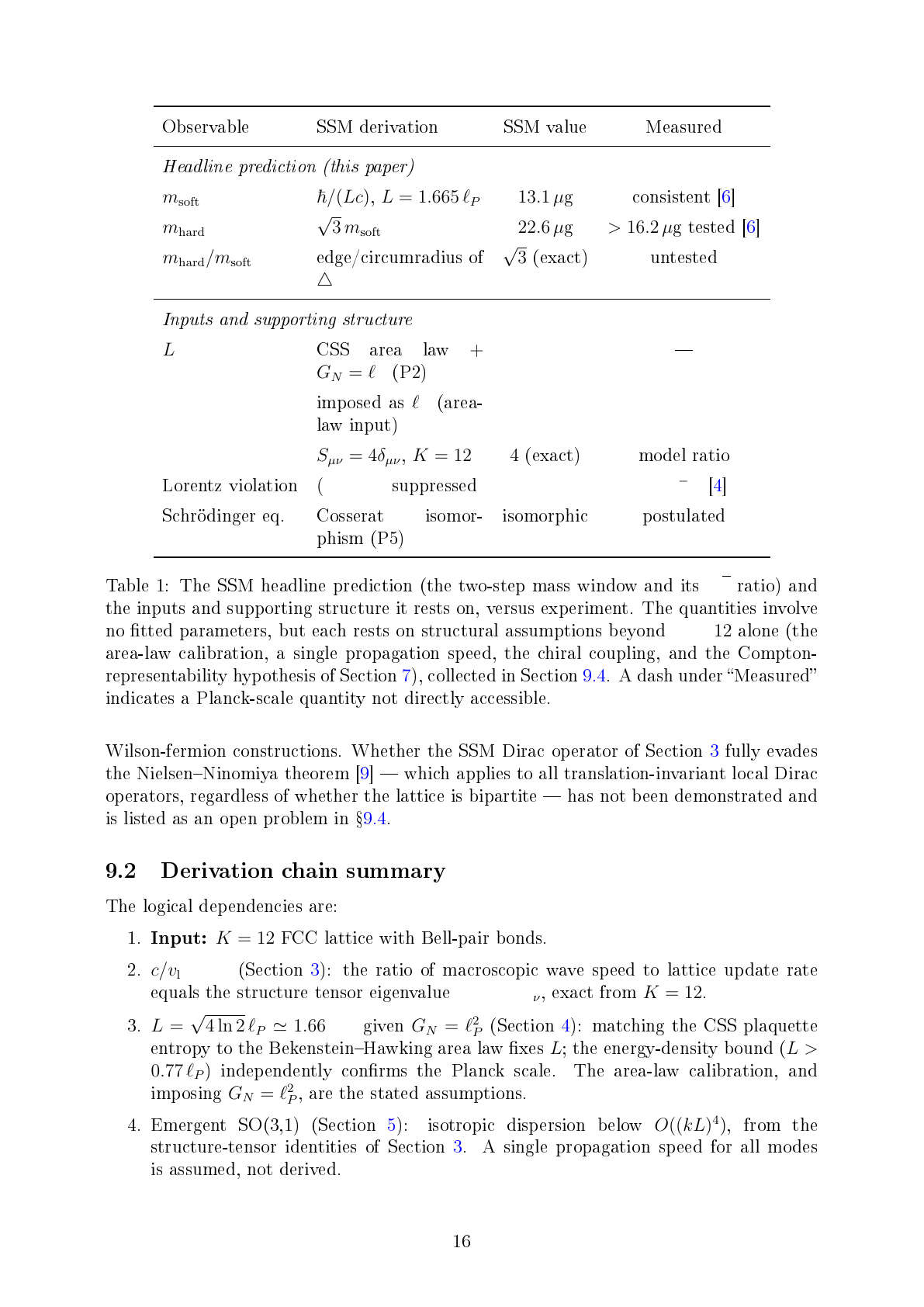
8 Experimental Comparison
Table 1 collects the headline prediction of this paper, together with the inputs and support-
ing structure it rests on, against the best available measurements. Each quantity follows
from the
K = 12
FCC lattice via the chain in Section 9.2, together with the additional
assumptions that the chain makes explicit; none involves a tted parameter.
Three entries warrant comment. The ratio
m
hard
/m
soft
=
√
3
is the sharpest near-term
prediction: it requires only two experiments bracketing the 13.122.6
µ
g window, calibrated
against each other, with no reference to any Standard Model parameter. Current acoustic-
resonator technology is within a factor of two of this range [6]; MAQRO [7] could reach it
within the decade. The Lorentz-violation prediction is consistent with current limits. The
model suppresses Lorentz-violating bulk operators by
(E/M
P
)
4
, which is of order
10
−112
at optical frequencies. This is a raw suppression factor rather than a specic Standard-
Model-Extension coecient, so it is not directly the same quantity as the tabulated bound
of order
10
−16
; the point is only that the predicted eect lies roughly
90
orders of magnitude
below any current sensitivity. The Schrödinger entry is unusual: the measured column
records what quantum mechanics assumes as a postulate, while the SSM column records a
structural isomorphism the
K = 12
Cosserat continuum limit takes the form of the free-
particle Schrödinger equation once a chiral translation-rotation coupling is supplied, with
the imaginary unit
i
entering through that coupling rather than being posited separately.
The coupling itself is conjectured, not derived (9.4).
9 Discussion
9.1 Why FCC and not another lattice?
The FCC lattice is selected by three requirements: (a) it saturates the Kepler bound (
K =
12
) [3]; (b) its four
{111}
families generate emergent SO(3), which no other 3D Bravais
lattice achieves; and (c) unlike the simple-cubic and BCC lattices, it is non-bipartite,
which modies where fermion doublers appear in the Brillouin zone compared to standard
15
Observable SSM derivation SSM value Measured
Headline prediction (this paper)
m
soft
ℏ/(Lc)
,
L = 1.665 ℓ
P
13.1 µ
g consistent [6]
m
hard
√
3 m
soft
22.6 µ
g
> 16.2 µ
g tested [6]
m
hard
/m
soft
edge/circumradius of
△
√
3
(exact) untested
Inputs and supporting structure
L
CSS area law
+
G
N
= ℓ
2
P
(P2)
1.665 ℓ
P
G
N
imposed as
ℓ
2
P
(area-
law input)
ℓ
2
P
ℓ
2
P
c/v
lat
S
µν
= 4δ
µν
,
K = 12 4
(exact) model ratio
Lorentz violation
(E/E
P
)
4
suppressed
∼(E/E
P
)
4
< 10
−16
[4]
Schrödinger eq. Cosserat isomor-
phism (P5)
isomorphic postulated
Table 1: The SSM headline prediction (the two-step mass window and its
√
3
ratio) and
the inputs and supporting structure it rests on, versus experiment. The quantities involve
no tted parameters, but each rests on structural assumptions beyond
K = 12
alone (the
area-law calibration, a single propagation speed, the chiral coupling, and the Compton-
representability hypothesis of Section 7), collected in Section 9.4. A dash under Measured
indicates a Planck-scale quantity not directly accessible.
Wilson-fermion constructions. Whether the SSM Dirac operator of Section 3 fully evades
the NielsenNinomiya theorem [9] which applies to all translation-invariant local Dirac
operators, regardless of whether the lattice is bipartite has not been demonstrated and
is listed as an open problem in 9.4.
9.2 Derivation chain summary
The logical dependencies are:
1.
Input:
K = 12
FCC lattice with Bell-pair bonds.
2.
c/v
lat
= 4
(Section 3): the ratio of macroscopic wave speed to lattice update rate
equals the structure tensor eigenvalue
S
µν
= 4δ
µν
, exact from
K = 12
.
3.
L =
√
4 ln 2 ℓ
P
≃ 1.665 ℓ
P
given
G
N
= ℓ
2
P
(Section 4): matching the CSS plaquette
entropy to the BekensteinHawking area law xes
L
; the energy-density bound (
L >
0.77 ℓ
P
) independently conrms the Planck scale. The area-law calibration, and
imposing
G
N
= ℓ
2
P
, are the stated assumptions.
4. Emergent SO(3,1) (Section 5): isotropic dispersion below
O((kL)
4
)
, from the
structure-tensor identities of Section 3. A single propagation speed for all modes
is assumed, not derived.
16
5. Schrödinger equation (Section 6): from the chiral Cosserat Lagrangian, conditional
on the conjectured coupling
Ω
.
6.
m
soft
= 13.1 µ
g,
m
hard
= 22.6 µ
g (Section 7): from
L
and the metric wall
r
min
= L/
√
3
,
under the Compton-representability hypothesis.
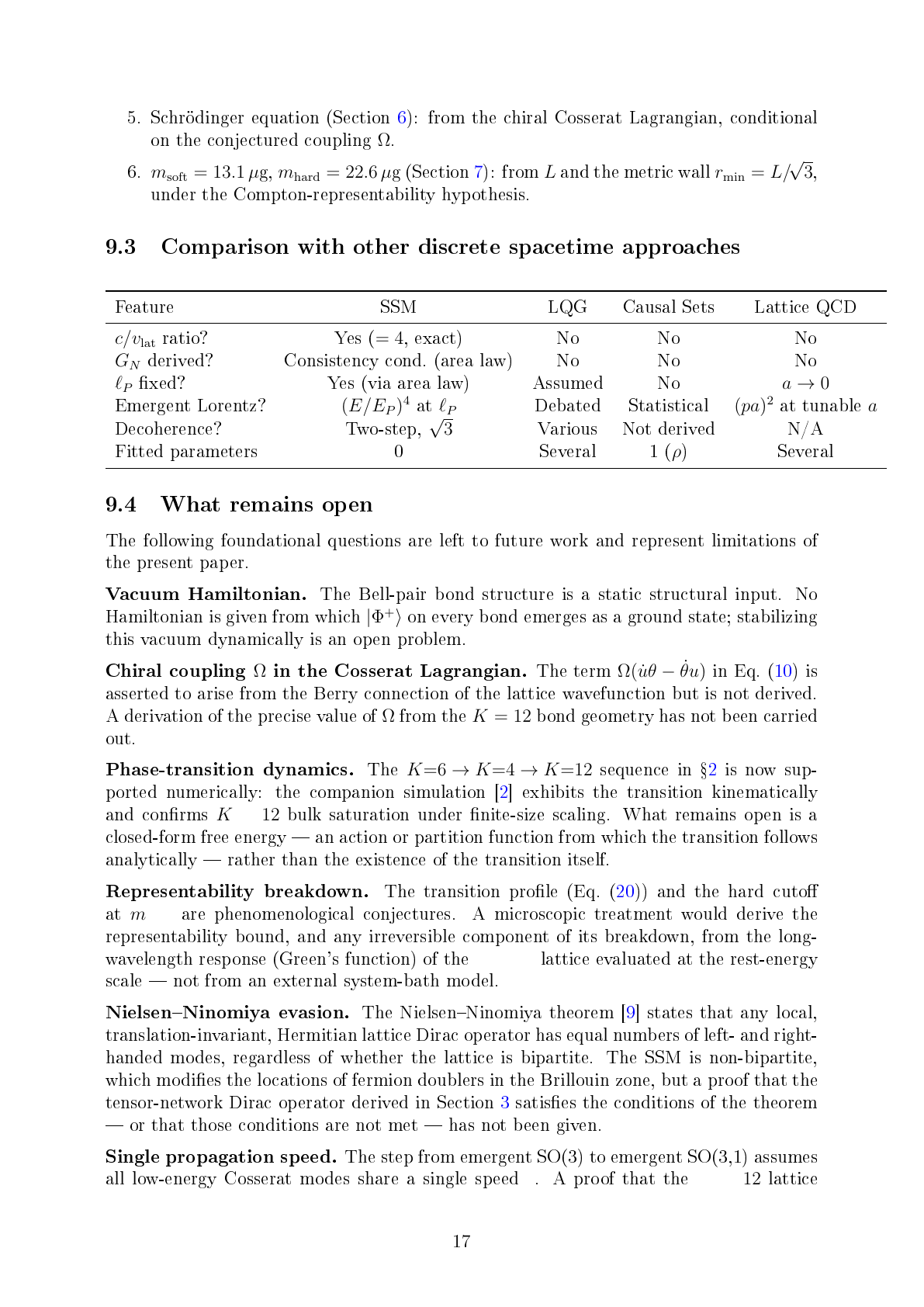
9.3 Comparison with other discrete spacetime approaches
Feature SSM LQG Causal Sets Lattice QCD
c/v
lat
ratio? Yes (
= 4
, exact) No No No
G
N
derived? Consistency cond. (area law) No No No
ℓ
P
xed? Yes (via area law) Assumed No
a → 0
Emergent Lorentz?
(E/E
P
)
4
at
ℓ
P
Debated Statistical
(pa)
2
at tunable
a
Decoherence? Two-step,
√
3
Various Not derived N/A
Fitted parameters 0 Several 1 (
ρ
) Several
9.4 What remains open
The following foundational questions are left to future work and represent limitations of
the present paper.
Vacuum Hamiltonian.
The Bell-pair bond structure is a static structural input. No
Hamiltonian is given from which
|Φ
+
⟩
on every bond emerges as a ground state; stabilizing
this vacuum dynamically is an open problem.
Chiral coupling
Ω
in the Cosserat Lagrangian.
The term
Ω( ˙uθ −
˙
θu)
in Eq. (10) is
asserted to arise from the Berry connection of the lattice wavefunction but is not derived.
A derivation of the precise value of
Ω
from the
K = 12
bond geometry has not been carried
out.
Phase-transition dynamics.
The
K=6 → K=4 → K=12
sequence in 2 is now sup-
ported numerically: the companion simulation [2] exhibits the transition kinematically
and conrms
K = 12
bulk saturation under nite-size scaling. What remains open is a
closed-form free energy an action or partition function from which the transition follows
analytically rather than the existence of the transition itself.
Representability breakdown.
The transition prole (Eq. (20)) and the hard cuto
at
m
hard
are phenomenological conjectures. A microscopic treatment would derive the
representability bound, and any irreversible component of its breakdown, from the long-
wavelength response (Green's function) of the
K = 12
lattice evaluated at the rest-energy
scale not from an external system-bath model.
NielsenNinomiya evasion.
The NielsenNinomiya theorem [9] states that any local,
translation-invariant, Hermitian lattice Dirac operator has equal numbers of left- and right-
handed modes, regardless of whether the lattice is bipartite. The SSM is non-bipartite,
which modies the locations of fermion doublers in the Brillouin zone, but a proof that the
tensor-network Dirac operator derived in Section 3 satises the conditions of the theorem
or that those conditions are not met has not been given.
Single propagation speed.
The step from emergent SO(3) to emergent SO(3,1) assumes
all low-energy Cosserat modes share a single speed
c
. A proof that the
K = 12
lattice
17
enforces this (rather than admitting dierent group velocities for dierent modes) has not
been given.
Two-step threshold prediction.
The ratio
m
hard
/m
soft
=
√
3
is the cleanest falsiable
prediction; it depends on no Standard Model input. The Standard Model gauge group,
quark masses, and cosmological parameters are addressed in separate papers.
9.5 Falsiability
Planck-suppressed Lorentz violation:
the model predicts violations at order
(E/E
P
)
4
∼ 10
−112
at optical frequencies, far below current bounds. Any detection of
birefringence or time-of-ight anomalies at energies well below
E
P
would falsify the
model.
Two-step structure
separated by exactly
√
3
, with an exactly null response below
m
soft
= 13.1 µ
g and a hard cuto at
m
hard
= 22.6 µ
g not the single smooth
threshold of DiósiPenrose.
Deterministic deformation
between the thresholds: a reversible dispersive distor-
tion
δ(m) =
1
6
(m/m
soft
)
2
that depends on the mass alone and not on the branch sep-
aration
∆x
; a mass scan at xed
∆x
separates this from the
∆x
-dependent stochastic
collapse of DiósiPenrose.
Area-law calibration:
the absolute window depends on the inferred lattice scale
L =
√
4 ln 2 ℓ
P
; if future short-distance gravity or entropy-area tests ruled out such
a scale, the absolute window would fail (the dimensionless
√
3
ratio would not).
10 Conclusion
The
K = 12
FCC vacuum predicts a two-step quantum-to-classical threshold for a
macroscopic center-of-mass superposition: a reversible dispersive deformation onsets at
m
soft
= 13.1 µ
g and coherence becomes geometrically unsustainable at
m
hard
= 22.6 µ
g,
separated by the exact, parameter-free ratio
√
3
from the edge-to-circumradius ratio of
the cuboctahedral triangular face. This is the paper's central, falsiable claim. The
√
3
ratio is pure triangle geometry; the absolute window depends on the bond length
L ≈ 1.665 ℓ
P
(xed by matching the CSS-code entropy to the BekensteinHawking area
law with
G
N
= ℓ
2
P
, P2) and on the Compton-representability hypothesis: that a mass ex-
citation remains a coherent lattice excitation only while its reduced Compton wavelength
is resolvable by the FCC geometry (P3). A mass scan across the
13.1
22.6 µ
g window
at xed branch separation discriminates it from the smooth,
∆x
-dependent threshold of
DiósiPenrose; the recent
16.2 µ
g cat-state oscillator sits between the thresholds, consistent
with surviving coherence.
The macroscopic constants enter as inputs and supporting structure, not as independent
results:
c/v
lat
= 4 = K/d
is a dimensionless ratio from the cuboctahedral structure tensor
(not the SI value of
c
);
G
N
= ℓ
2
P
is imposed, not derived, and xes
L
through the area-
law calibration; and the Cosserat continuum limit takes Schrödinger form only once the
conjectured chiral coupling (P5) is supplied. Emergent Lorentz invariance, with violations
suppressed at order
(E/E
P
)
4
, follows from the structure-tensor identities of Section 3.
The central prediction the two-step threshold with ratio
√
3
remains untested and
is the natural target for the next generation of macroscopic-superposition experiments.
18
Its weakest required assumption is P3, the Compton-representability hypothesis: that
a mass excitation remains a coherent lattice excitation only while its reduced Compton
wavelength is resolvable by the FCC geometry, not while its branch separation stays small.
The prediction stands or falls with that assumption, which we have stated as plainly as we
can.
Author Contributions
Raghu Kulkarni:
Conceptualization; Methodology; Formal analysis; Investigation; Writ-
ing original draft; Writing review & editing; Visualization; Funding acquisition.
Data Availability
No new datasets were generated or analyzed in this study. The two geometric inputs taken
from simulation (the metric wall at
L/
√
3
and the
{111}
interlayer spacing) are drawn from
the published companion work [2]; all other results follow analytically from the geometric
framework described in the text.
Declaration of Competing Interests
The author declares no competing interests.
Funding
This work was supported internally by IDrive Inc. No external funding was received.
19
References
[1] R. Kulkarni, A 67%-rate CSS code on the FCC lattice:
[[192, 130, 3]]
from weight-12
stabilizers, arXiv:2603.20294 [quant-ph] (2026). arXiv:2603.20294.
[2] R. Kulkarni, Matter as incomplete crystallization: quark charges, color connement,
and the proton mass from a single extra node in the vacuum lattice,
Phys. Open
27
,
100423 (2026). doi:10.1016/j.physo.2026.100423.
[3] T. C. Hales, A proof of the Kepler conjecture,
Ann. Math.
162
, 1065 (2005).
doi:10.4007/annals.2005.162.1065.
[4] V. A. Kostelecký and N. Russell, Data tables for Lorentz and CPT violation,
Rev.
Mod. Phys.
83
, 11 (2011). doi:10.1103/RevModPhys.83.11.
[5] R. Penrose, On gravity's role in quantum state reduction,
Gen. Relativ. Gravit.
28
,
581 (1996). doi:10.1007/BF02105068.
[6] M. Bild, M. Fadel, Y. Yang, U. von Lüpke, P. Martin, A. Bruno, and Y. Chu,
Schrödinger cat states of a 16-microgram mechanical oscillator,
Science
380
, 274
(2023). doi:10.1126/science.adf7553.
[7] R. Kaltenbaek et al., Macroscopic quantum resonators (MAQRO),
Exp. Astron.
34
,
123 (2012). doi:10.1007/s10686-012-9292-3.
[8] A. C. Eringen,
Microcontinuum Field Theories I: Foundations and Solids
(Springer,
1999). doi:10.1007/978-1-4612-0555-5.
[9] H. B. Nielsen and M. Ninomiya, Absence of neutrinos on a lattice (I): proof by
homotopy theory,
Nucl. Phys. B
185
, 20 (1981). doi:10.1016/0550-3213(81)90361-8.
[10] S.-Y. Lan, P.-C. Kuan, B. Estey, D. English, J. M. Brown, M. A. Hohensee, and H.
Müller, A clock directly linking time to a particle's mass,
Science
339
, 554 (2013).
doi:10.1126/science.1230767.
[11] I. Montvay and G. Münster,
Quantum Fields on a Lattice
(Cambridge University
Press, 1994). doi:10.1017/CBO9780511470783.
[12] Y. Y. Fein, P. Geyer, P. Zwick, F. Kiaªka, S. Pedalino, M. Mayor, S. Gerlich, and
M. Arndt, Quantum superposition of molecules beyond 25 kDa,
Nat. Phys.
15
, 1242
(2019). doi:10.1038/s41567-019-0663-9.
20
