Emergence of cosmic atness, ination, and reheating
from topological phase transitions in a discrete
vacuum
Raghu Kulkarni
SSMTheory Group, IDrive Inc., Calabasas, CA 91302, USA
raghu@idrive.com
May 2026
Abstract
Standard inationary cosmology [1, 2] solves the atness, horizon, and monopole
problems by postulating a scalar inaton with a ne-tuned potential. We develop
a single-parameter geometric alternative in which these phenomena are thermo-
dynamic consequences of topological phase transitions of a discrete vacuum. The
substrate is a dynamic tensor network that passes through three phases: a two-
dimensional hexagonal ground state (
⟨K⟩ = 6
), a frustrated three-dimensional tetra-
hedral foam (
K = 4
), and a saturated Face-Centered Cubic crystal (
K = 12
), the
last of which carries an explicit quantum error-correcting code structure derived in
the companion paper [27]. The Euler characteristic of a 2D triangulated manifold
forces the average vertex coordination to
⟨K⟩ = 6
, giving
χ → 0
and imposing cos-
mic atness (
Ω
k
= 0
) at the level of the ground state. A computational study of
the
K = 4 → K = 12
kinematics [29] locates a sharp geometric exclusion at the
metric-wall distance
L/
√
3 ≈ 0.577 L
, providing a parameter-free regulator that re-
places the classical zero-dimensional singularity. Out-of-plane nucleation drives the
network into the
K = 4
foam. Regular tetrahedra cannot tile Euclidean space and
leave an irreducible Regge decit
δ = 2π −5 arccos(1/3) ≈ 0.128
rad [14]. This frus-
tration acts as a constant positive scalar curvature and sources a De Sitter epoch.
With
η ≡ δ/(2π) ≈ 0.0204
the only intrinsic small dimensionless parameter of the
lattice, the scalar tilt is forced to the form
1 − n
s
= c
1
η + O(η
2
)
with
c
1
= O(1)
;
Planck 2018 data [13] pin
c
1
= 1.72±0.21
. Independently of
c
1
, near-scale-invariance
is forced by the smallness of
η
and the tensor-to-scalar ratio is suppressed (
r → 0
)
because
δ
is a xed structural constant. The transition into the
K = 12
FCC crystal
releases a latent heat of order
4ε
per node; xing the single continuous parameter
ε
at the GUT scale gives a reheating temperature
T
reheat
∼ 10
15
GeV consistent
with BBN bounds [18]. We also establish (i) emergent Lorentz invariance from the
centrosymmetric, isotropic structure tensor of the FCC bond set, and (ii) a spec-
tral identity
48/72 = 2/3
of the graph Laplacian of the 13-node FCC coordination
cluster that is numerically close to the observed dark energy fraction
Ω
Λ
≈ 0.685
.
Together with the particle-spectrum analysis [28] and the trapped-defect interpre-
tation of matter [29], the framework reframes the early universe as a sequence of
topological phase transitions rather than the dynamics of a ne-tuned inaton.
1
Contents
1 Introduction 3
2 Phase I: Cosmic atness from the Euler characteristic 3
2.1 The network Hamiltonian . . . . . . . . . . . . . . . . . . . . . . . . . . . 3
2.2 The kinematic stitching operator . . . . . . . . . . . . . . . . . . . . . . . 3
2.3 Emergent time and causal structure . . . . . . . . . . . . . . . . . . . . . . 4
2.4 The
K = 6
atness constraint . . . . . . . . . . . . . . . . . . . . . . . . . 4
2.5 The
L/
√
3
geometric cut-o . . . . . . . . . . . . . . . . . . . . . . . . . . 5
3 Phase II: Tetrahedral foam and geometric ination 5
3.1 Holographic nucleation and the Regge decit angle . . . . . . . . . . . . . 5
3.2 De Sitter expansion . . . . . . . . . . . . . . . . . . . . . . . . . . . . . . . 7
3.3 Scalar tilt . . . . . . . . . . . . . . . . . . . . . . . . . . . . . . . . . . . . 7
4 Transition dynamics and timescales 8
4.1 The
K = 6 → K = 4
nucleation rate . . . . . . . . . . . . . . . . . . . . . 8
4.2 The
K = 4 → K = 12
crystallization . . . . . . . . . . . . . . . . . . . . . 9
5 Phase III: Saturation and reheating 9
5.1 The
K = 12
crystallization . . . . . . . . . . . . . . . . . . . . . . . . . . . 9
5.2 Latent heat of crystallization . . . . . . . . . . . . . . . . . . . . . . . . . . 9
5.3 Why three dimensions . . . . . . . . . . . . . . . . . . . . . . . . . . . . . 10
6 Connection to the particle spectrum and matter 10
6.1 The FCC vacuum as a CSS quantum code . . . . . . . . . . . . . . . . . . 10
6.2 Particles as defects of the FCC code . . . . . . . . . . . . . . . . . . . . . . 10
6.3 Arithmetic equivalence of the two mass derivations . . . . . . . . . . . . . 11
6.4 Photons as gapless vibrational modes . . . . . . . . . . . . . . . . . . . . . 11
7 The Laplacian spectrum of the FCC cluster and the cosmic energy bud-
get 11
7.1 Self-contained computation of the spectrum . . . . . . . . . . . . . . . . . 12
7.2 Physical decomposition of the modes . . . . . . . . . . . . . . . . . . . . . 12
7.3 Cosmological identication . . . . . . . . . . . . . . . . . . . . . . . . . . . 13
8 The continuum limit: exact Lorentz invariance 13
8.1 Exact spatial isotropy at the lattice level . . . . . . . . . . . . . . . . . . . 13
8.2 Isotropic dispersion and emergent boosts . . . . . . . . . . . . . . . . . . . 14
8.3 Metric structure . . . . . . . . . . . . . . . . . . . . . . . . . . . . . . . . . 14
9 Equivalence mapping and recovery of general relativity 14
9.1 Standard cosmology mapping . . . . . . . . . . . . . . . . . . . . . . . . . 14
9.2 Recovery of general relativity in the continuum limit . . . . . . . . . . . . 14
10 Conclusions 15
2
1 Introduction
The inationary framework solves the atness, horizon, and monopole problems of the
standard Big Bang at a cost: an unobserved scalar eld (the inaton) governed by a tightly
constrained potential [1, 2]. The motivation for this paper is to ask whether ination and
reheating can instead be driven by structural phase transitions of a discrete vacuum.
We take the ontology of the network seriously. Following the identication of geometry
with entanglement [3, 4, 5], we do not treat the graph as a discretization of a background
manifold. The edges of the graph
are
the fundamental quantum entanglement bonds.
Spacetime is the emergent hydrodynamic limit of this structure.
The approach has features in common with spin networks [6, 7] and with causal sets [8]:
the kinematics of nodes generates a causal order. Our network diers from a pure partial
order by carrying a rigid metric structure set by the three-dimensional kissing number [9].
The vacuum is not assumed to begin in three at macroscopic dimensions. It evolves
through a sequence determined by energy minimization, geometric frustration, and di-
mensional saturation. The major epochs of the early universe map onto a sequence of
coordination numbers:
K = 6
(a 2D planar Genesis),
K = 4
(a frustrated foam that
drives De Sitter ination), and
K = 12
(a saturated FCC crystal that triggers reheating).
Once the
K = 12
crystal forms, it is the substrate on which the
[[192, 130, 3]]
CSS code of
Ref. [27] is built and on which the particle spectrum of Refs. [28, 29] is realized as a nite
set of stable topological defects.
2 Phase I: Cosmic atness from the Euler characteristic
2.1 The network Hamiltonian
We model the pre-geometric vacuum as a dynamic graph
G(V, E)
evolving under a
stabilizer-type Hamiltonian that maximizes the number of edges while penalizing extreme
local coordination:
H = −ε
X
⟨i,j⟩
A
ij
+ λ
X
v
Φ(K
v
).
(1)
Here
ε
is the binding energy of a single unitary entanglement link (the one continuous
parameter of the model),
A
ij
is the adjacency matrix, and
Φ(K
v
)
is a local penalty
bounding node density [11]. As shown in Section 2.4, the precise form of
Φ
does not
aect our conclusions: the ground-state coordination
⟨K⟩ = 6
follows from a topological
constraint on the 2D triangulation, not from a tuned potential.
2.2 The kinematic stitching operator
Standard lattice gauge theories place elds on a static background grid. The Selection-
Stitch Model (SSM) treats space itself as a dynamical observable. The vacuum is an active
tensor network maintained by a continuous process that we call the Kinematic Stitching
Operator
ˆ
S
.
As
G(V, E)
evolves under (1), macroscopic stretching of existing nodes induces local
geometric strain that threatens to drop the coordination below the topological saturation
threshold
K
sat
. To stop the lattice from tearing,
ˆ
S
nucleates and binds new nodes wherever
K < K
sat
. Adding a node increases the Hilbert-space dimension, so
ˆ
S
is an isometric
3
embedding from a pre-geometric reservoir rather than a strictly unitary map:
ˆ
S |ψ
K<K
sat
⟩ −→ |ψ
K=K
sat
⟩.
(2)
We characterize
ˆ
S
by its kinematic consequence rather than by explicit Kraus opera-
tors. Cosmic expansion in this picture is not the stretching of an empty void; it is the
thermodynamic shadow of microscopic stitching needed to keep the structure intact.
A concrete realization of the same mechanism is the stitch/lift cascade studied in
Ref. [29]. At xed unit bond length, only two operators preserve unit distance: the stitch,
which places a new node at the equilateral apex above an existing edge, and the lift, which
places a node above the centroid of a triangular face at height
h =
p
2/3 L
. A 4-sphere
intersection at unit distance in
R
3
is generically empty, so no third operator exists. The
cascade closes once the kissing-number bound
K = 12
is reached.
2.3 Emergent time and causal structure
Neither space nor time is a pre-existing background. Space is constituted by
G(V, E)
.
Time emerges as the causal ordering of stitching events. Each application of
ˆ
S
is one
discrete tick of the microscopic clock. The continuum parameter
t
arises from coarse-
graining,
t = lim
N→∞
N τ
stitch
, τ
stitch
∼ t
P
,
(3)
in the same spirit as the emergence of time in causal dynamical triangulations [12] and
causal sets [8]. The light cone at a vertex is the set of vertices reachable within
n
stitching
steps.
2.4 The
K = 6
atness constraint
The atness problem [10] asks why the observable universe has spatial curvature
Ω
k
=
0 ± 0.002
[13]. Continuum cosmology answers this with ne-tuning of initial conditions.
Here, atness emerges from the ground state.
In the pre-volumetric state, the nascent network closes minimal entanglement loops
(triangles) without inducing 3D stress. The global topology of a 2D triangulated surface
is set by the Euler characteristic
χ = V − E + F.
(4)
For a closed triangulated manifold,
3F = 2E
and
2E = V ⟨K⟩
, giving
χ = V
1 −
⟨K⟩
6
.
(5)
Out-of-plane dimensionality carries an entropic penalty in the early universe, so the
Hamiltonian rst minimizes in two dimensions. Edge-maximization then drives the lat-
tice into the densest 2D triangulated packing, the at hexagonal plane with
⟨K⟩ = 6
.
Equation (5) then forces
χ → 0
identically.
The fundamental ground state of the network is geometrically at. When uctuations
later force out-of-plane nucleation, the 3D volume inherits this zero-curvature boundary
condition. Flatness becomes a topological constraint rather than a tuning of initial data.
4
2.5 The
L/
√
3
geometric cut-o
Continuum cosmology extrapolates the expanding universe to a mathematical singularity.
The discrete lattice avoids this. For a triangulation of equilateral faces of edge
L
, the in-
plane distance from the centroid of a triangular face to any of its vertices is exactly
L/
√
3 ≈ 0.577 L
. This is the
metric wall
: a node placed at the centroid of such a face
would lie within unit-bond-length range of all three triangle vertices, an over-constrained
conguration that the discrete kinematics rejects.
A sweep of the kinematic phase diagram reported in Ref. [29] veries this scale directly.
The maximum bulk coordination
K
max
is locked at
12
across a broad plateau
R
ex
∈
[0.58, 0.99] L
. Below
L/
√
3
exclusion fails and unphysical
K
max
> 12
overlaps appear;
above
L
the lattice freezes (
K
max
collapses to 23). The plateau is a sharp phase boundary,
not a tuned cut-o.
If the universe is compressed below this exclusion threshold, the 3D structure breaks
and nodes collapse into the 2D faces of adjacent layers. The 0D singularity is avoided.
Gravitational reversal forces dimensional reduction back into the foundational 2D planar
sheet (
K = 6
). Genesis begins as a two-dimensional holographic boundary.
3 Phase II: Tetrahedral foam and geometric ination
3.1 Holographic nucleation and the Regge decit angle
As the planar network grows, uctuations bridge the entropic barrier and force the nucle-
ation of out-of-plane vertices, activating the lift operator above. The minimal 3D simplex
produced this way is the regular tetrahedron (
K = 4
). This transition marks the onset of
the volumetric universe.
A geometric constraint dominates the new phase: regular tetrahedra do not tile 3D
Euclidean space. The dihedral angle of a regular tetrahedron is
θ = arccos(1/3) ≈ 70.5288
◦
≈ 1.2310 rad.
(6)
Packing ve tetrahedra around a shared central edge consumes
5θ ≈ 352.6439
◦
. The
network fails to close, leaving a structural gap. In Regge calculus [14] this gap is the
decit angle (Fig. 1)
δ = 2π − 5θ ≈ 0.128388 rad ≈ 7.3561
◦
.
(7)
Interactive visualization.
A supplementary WebGL application shows the full
K =
6 → K = 4 → K = 12
sequence through eight stages: (i) the initial Bell pair, (ii) the
rst triangular face from the stitch operator, (iii) the growing hexagonal ring, (iv) the
completed at
K = 6
ground state, (v) the rst tetrahedral lift at height
h =
p
2/3 L
,
(vi) the
K = 4
foam, (vii) a zoom of ve tetrahedra around a shared edge with the
7.36
◦
decit wedge, and (viii) the
K = 12
cuboctahedral coordination shell with the
6+3+3
decomposition of nearest neighbors. The visualization is at
https://raghu91302.
github.io/ssmtheory/ssm_regge_deficit.html
.
5
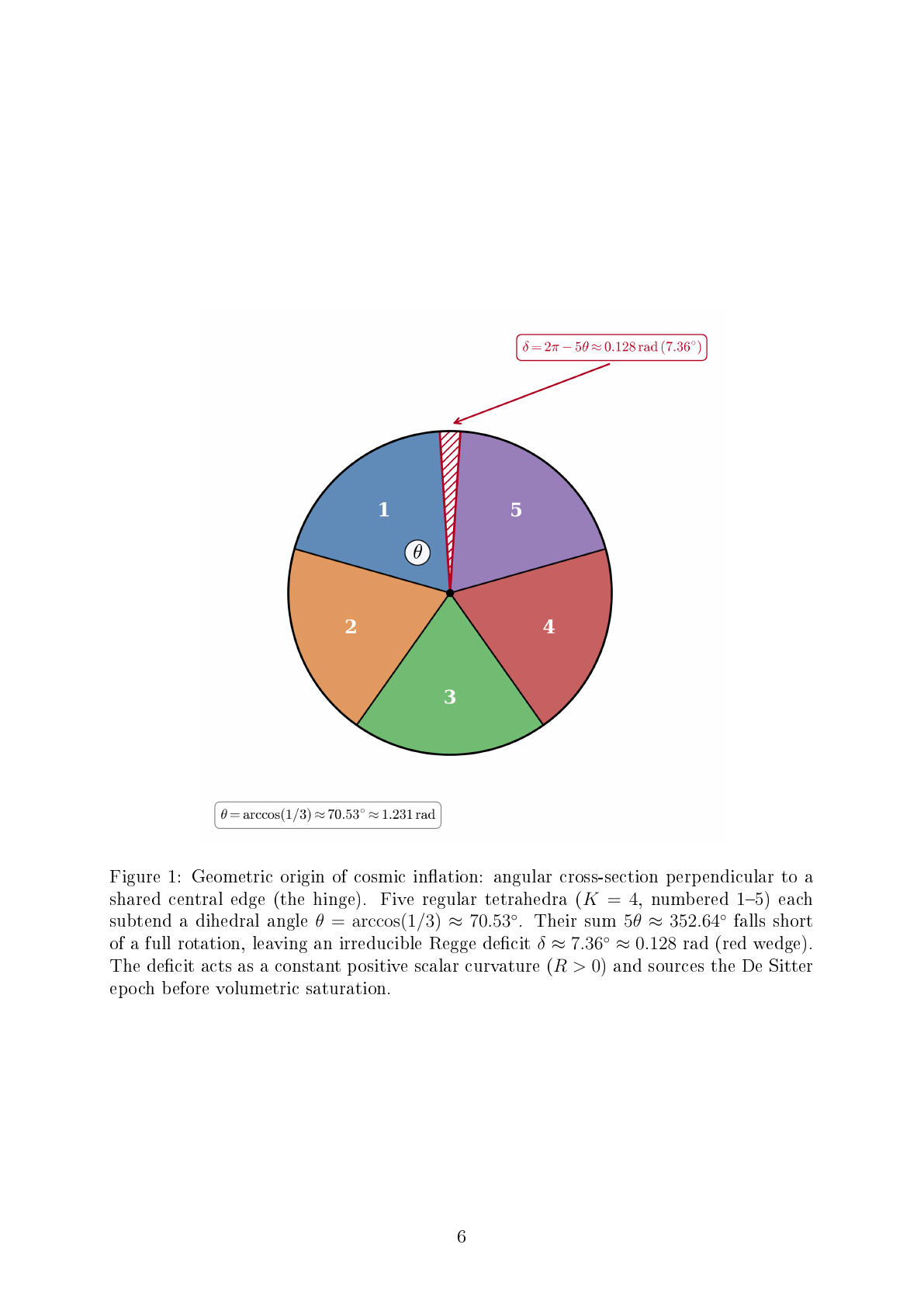
Figure 1: Geometric origin of cosmic ination: angular cross-section perpendicular to a
shared central edge (the hinge). Five regular tetrahedra (
K = 4
, numbered 15) each
subtend a dihedral angle
θ = arccos(1/3) ≈ 70.53
◦
. Their sum
5θ ≈ 352.64
◦
falls short
of a full rotation, leaving an irreducible Regge decit
δ ≈ 7.36
◦
≈ 0.128
rad (red wedge).
The decit acts as a constant positive scalar curvature (
R > 0
) and sources the De Sitter
epoch before volumetric saturation.
6
3.2 De Sitter expansion
Fix the fundamental lattice spacing at the bare Planck length,
L ≡ ℓ
P
. In discrete lattice
gravity, the scalar curvature at a hinge is the decit angle divided by the associated
area [15]. For Planck-scale simplices, the local macroscopic curvature scales as
R
local
≈
δ
ℓ
2
P
≈
0.128
ℓ
2
P
.
(8)
A constant positive scalar curvature denes a De Sitter spacetime. In four-dimensional
De Sitter space the Ricci scalar is related to the cosmological constant by
R = 4Λ
in the
convention
R
µν
= Λg
µν
. The topological frustration generates an eective cosmological
constant
Λ
eff
≈
R
local
4
≈
0.032
ℓ
2
P
,
(9)
which feeds the Friedmann equation as
a(t) ∝ e
H
inf
t
, H
inf
∝
p
Λ
eff
.
(10)
Ination in this picture is the macroscopic shadow of
ˆ
S
nucleating
K = 4
nodes from the
pre-geometric reservoir to heal the decit. The driver is Euclidean geometry, not a tuned
scalar potential.
3.3 Scalar tilt
The intrinsic small parameter.
The
K = 4
foam contains exactly one intrinsic small
dimensionless number, the tetrahedral Regge decit (7) normalized to a full rotation,
η ≡
δ
2π
=
2π − 5 arccos(1/3)
2π
≈ 0.020434.
(11)
Every other quantity in the lattice description is either an integer (
K = 4
,
K = 12
,
13
,
36
,
51
,
72
), an algebraic constant of order unity (
√
2
,
√
3
,
1/
√
3
), or the energy scale
ε
.
None of these is small. Combinations like
(Hℓ
P
)
2
∼ δ/12
inherit smallness from
δ
, not
from a new small number. Any dimensionless tilt sourced by the discrete geometry is
therefore a power series in
η
.
Form of the leading tilt.
The scalar tilt is dimensionless, so a Taylor expansion in
η
has the form
1 − n
s
= c
1
η + c
2
η
2
+ c
3
η
3
+ ··· ,
(12)
with coecients
c
n
of order unity set by lattice physics. Numerically,
η ≈ 2.04 × 10
−2
,
η
2
≈ 4.18 × 10
−4
,
η
3
≈ 8.5 × 10
−6
. Planck's
1σ
uncertainty on
1 − n
s
is
±4.2 × 10
−3
,
so higher-order terms contribute at most
|c
2
| · 10
−4
and are invisible at current precision
unless
|c
2
| ≳ 40
. To current observational precision,
1 − n
s
= c
1
η + O(η
2
), |c
1
| ∼ 1.
(13)
Equation (13) is rigorous: it follows from
η
being the only small dimensionless number,
from the requirement that
1 − n
s
depend on it as a power series, and from the smallness
of
η
.
7
The leading coecient.
The leading coecient
c
1
packages the lattice physics not
yet available in closed form: the normalization of the curvature operator at a hinge, the
mode-by-mode coupling to the comoving curvature perturbation
R
, the De Sitter phase-
space measure, and any backreaction Jacobians. Inverting (13) against the Planck 2018
measurement [13]
1 − n
s
= 0.0351 ± 0.0042
gives
c
1
=
1 − n
s
η
=
0.0351 ± 0.0042
0.020434
= 1.72 ± 0.21 (1σ).
(14)
The values
√
3 ≈ 1.732
,
π/
√
3 ≈ 1.814
,
5/3 ≈ 1.667
, and
7/4 = 1.75
all lie inside this
window; Planck data alone cannot distinguish them.
Predictions independent of
c
1
.
Two robust statements about the scalar spectrum
follow from the discrete structure alone, independently of the value of
c
1
.
(i) Near-scale-invariance is forced.
Because
η
is small and is the only small parameter,
the tilt is necessarily small:
|1 − n
s
| ≲ |c
1
|η ≈ 0.02|c
1
|
. A scale-invariant spectrum
(
n
s
→ 1
) recovers in the limit
δ → 0
, which corresponds to a hypothetical Euclidean-
tilable simplex. The observed deviation from scale invariance is a structural ngerprint
of geometric frustration.
(ii) The tensor-to-scalar ratio vanishes.
The decit
δ
is a xed structural constant of
the regular tetrahedron, not a rolling scalar eld. The standard slow-roll parameter
ϵ
V
∝
(V
′
/V )
2
is identically zero, and
r → 0
. A detection of primordial
B
-modes corresponding
to
r ≳ 10
−3
falsies the model.
Path to a rst-principles value of
c
1
.
A rst-principles determination of
c
1
requires
(a) expanding the Regge action
S =
1
8πG
P
h
A
h
δ
h
to quadratic order around the
K = 4
foam [21, 15], (b) quantizing the resulting graviton propagator on the De Sitter back-
ground sourced by (9), and (c) computing the curvature two-point function at horizon
crossing. A value of
c
1
inside the Planck window (14) conrms the structural prediction;
a value outside the window (for example
c
1
≈ 2.5
or
c
1
≈ 0.5
) falsies it.
4 Transition dynamics and timescales
4.1 The
K = 6 → K = 4
nucleation rate
The transition from the 2D hexagonal ground state to the 3D tetrahedral foam proceeds
by tunneling through an entropic barrier. The tunneling rate per unit area is
Γ
6→4
=
AT
2
exp(−S
E
/T )
in semiclassical nucleation theory.
Creating one out-of-plane vertex requires breaking three planar bonds (cost
3ε
) and
forming four tetrahedral half-bonds (gain
2ε
), so the net barrier is
∆E
barrier
= ε
. The
Euclidean action for a thin-wall bubble of radius
r
has the ColemanDe Luccia form [19],
and extremizing gives a critical bounce action
S
∗
E
∼ πε
. At Planck temperatures
T ∼ M
P
with
ε
at the GUT scale,
S
∗
E
/T ∼ O(10
−3
)
. Nucleation is not exponentially suppressed
and the
K = 6 → K = 4
transition is eectively instantaneous once thermal uctuations
reach the Planck scale.
8
4.2 The
K = 4 → K = 12
crystallization
While the local tunneling is fast, the global completion of the second transition is bounded
by the discrete kinematics of the
K = 4
foam. The simulation in Ref. [29] pins down two
quantitative properties of this transition that are needed below.
First, only two kinematic operators preserve unit bond length, and a 4-sphere in-
tersection at unit distance in
R
3
is generically empty, so no third operator exists. The
cascade closes at
K = 12
, the 3D kissing-number bound [9]. Direct measurement on
the simulated lattice conrms this: the bulk modal coordination is exactly
K = 12
at
every system size from
N = 250
upward, and the
K = 12
saturation fraction follows a
surface-to-volume scaling law
f
K=12
(N) = 1 − α/N
1/3
with
α = 6.8 ± 0.6
, extrapolating
to full FCC saturation in the thermodynamic limit [29].
Second, the relative amplitude of lift to stitch is xed at
P
lift
= e
−3
≈ 4.98%
, the
unique exponential suppression consistent with FCC saturation. Smaller values produce
2D sheets that never interlock; larger values produce 3D foams that fail to reach
K = 12
.
In cosmological terms, the runaway nucleation of new volume during the
K = 4
De Sitter epoch is not an instantaneous ash. It is a nite, geometrically rate-limited
curing process whose speed is bounded by the propagation of
ˆ
S
across the causal horizon.
A detailed analysis of any resulting global age gradient lies beyond the scope of this paper.
5 Phase III: Saturation and reheating
5.1 The
K = 12
crystallization
As the
K = 4
foam expands, it nucleates new nodes to bridge local decit angles. Node
density eventually reaches the 3D saturation limit. At this threshold the frustrated
K = 4
glass undergoes a global rst-order phase transition [16, 17] into the FCC lattice with
coordination
K = 12
at every interior node. The cuboctahedral coordination shell de-
composes into 6 in-plane nearest neighbors plus 3 above and 3 below (the ABC stacking
of FCC) and saturates the 3D kissing-number bound [9]. The per-site crystallization time
is
τ
cryst
∼ ℓ
P
/c
s
∼ t
P
.
5.2 Latent heat of crystallization
In this picture,
reheating is the latent heat of crystallization
released by the topological
transition. Each node in the
K = 4
foam has 4 half-bonds, giving structural binding
energy
E
K=4
= 2ε
per node. Each node in the saturated
K = 12
FCC lattice has 12
shared bonds, equivalent to
E
K=12
= 6ε
. The latent heat per node is
∆Q = E
K=12
− E
K=4
= (6 − 2) ε = 4ε.
(15)
The release of binding energy thermalizes the newly formed grid. Fix the single con-
tinuous parameter
ε
at the GUT scale (
ε ∼ 10
15
GeV) and the result is an ambient
thermal bath of
T
reheat
∼ 10
15
GeV. The reheating temperature is controlled by
ε
, but
the value
∼ 10
15
GeV is the same one required by standard
Λ
CDM to preserve Big Bang
Nucleosynthesis [18].
9
5.3 Why three dimensions
If geometric frustration drives the 2D sheet (
K = 6
) to project into a 3D bulk (
K = 12
),
why does the 3D crystal not project into a 4D hyper-crystal (
K = 24
)? The projection
stops at three dimensions because of two structural constraints.
Kinematic veto.
Macroscopic isotropy requires
K/D
to be an integer (
6/2 = 3
,
12/3 = 4
). Reaching the 4D kissing number
K = 24
requires passing through intermediate
states such as
K = 13
. Thirteen vectors cannot symmetrically sum to zero in 3D, so the
step breaks Lorentz invariance and is kinematically blocked.
Topological veto.
The 2D-to-3D projection is driven by exposed, at triangular
faces. Once the 3D FCC crystal forms, every tetrahedral and octahedral cell is surrounded
by adjacent cells. No exposed faces point into a fourth spatial dimension and there is
nothing to project.
The
K = 12
crystal is the boundary at which geometry, thermodynamics, and kine-
matics saturate together. Space freezes into three dimensions.
6 Connection to the particle spectrum and matter
The saturated
K = 12
FCC vacuum is not only the substrate of the cosmological tran-
sitions above. It is the substrate on which the explicit quantum error-correcting code of
Ref. [27] and the particle-spectrum analyses of Refs. [28, 29] are built. We summarize
the relevant content here so the present paper is self-contained, without repeating those
derivations.
6.1 The FCC vacuum as a CSS quantum code
Place one physical qubit on every edge of the FCC lattice. Dene
Z
-stabilizers at every
vertex (acting on the 12 incident edges) and
X
-stabilizers at every octahedral void (acting
on the 12 edges connecting its 6 surrounding vertices). This is a CalderbankShorSteane
stabilizer code on the lattice. At linear size
L = 4
, computational verication gives
the code parameters
[[n, k, d]] = [[192, 130, 3]]
with uniform weight-12 stabilizers and an
encoding rate of
67.7%
[27]. The minimum distance is proven by exhaustive elimination of
all weight-
≤ 2
candidates together with constructive weight-3 codewords. Asymptotically
the rate locks at
k/n → 2/3
at xed
d = 3
. The high rate originates in a structural surplus
of edges over independent stabilizer constraints: the FCC lattice supplies
3L
3
edges but
only
L
3
− 2
independent stabilizers, leaving
k = 2L
3
+ 2
logical degrees of freedom.
This code is the topological back-end of the cosmological story. The present paper
builds the
K = 12
vacuum; Ref. [27] shows the same vacuum is a high-rate CSS code;
Refs. [28, 29] recover the particle spectrum as the unique set of stable defects of that code.
6.2 Particles as defects of the FCC code
Reference [28] enumerates all defect geometries supported by the 13-node FCC coordi-
nation cluster (one origin node plus its 12 nearest neighbors). Defects are classied by
structural footprint (1-, 2-, or 3-sheet), gauge sector (trivial, vertex, electromagnetic
F
□
,
conned, or full
V + F
), and dynamical state (static, moving, or string-closed). Four
physical axioms grounded in standard QEC theory and lattice gauge theory (minimum
topological dimension, sector completeness, boundary closure, kinematic shedding) reduce
10
25 candidate congurations to exactly 5 stable states. Their fault-tolerant verication
costs
C
x
= E
s
× C
s
(the dimension of the syndrome-extraction coupling matrix) match
the empirical mass ratios of the electron, muon, pion, proton, and neutron to within
0.12%
:
C
e
= 1
,
C
µ
= 207
,
C
π
= 273
,
C
p
= 1836
,
C
n
= 1839
. No continuous parameters
are tted.
Reference [29] reaches the same physics from a complementary direction: matter is
a single extra node trapped in a tetrahedral void of the FCC lattice, a frozen fragment
of the
K = 4
phase that failed to integrate during the crystallization event of Section 4.
The single defect gives the fractional electric charges
{−1/3, +2/3}
from the regular-
tetrahedron bond-angle cosine and integer winding under the FCC Bravais translation
group, the three color charges from the three skew-edge pairs of the bounding
K
4
, linear
connement from the
L/
√
3
metric wall, and the proton-to-electron mass ratio
m
p
m
e
= (K + 1) K
2
− c
skew
K = 13 × 144 − 3 × 12 = 1836,
(16)
matching the empirical value
1836.153
to within
0.008%
[29].
6.3 Arithmetic equivalence of the two mass derivations
The two derivations land on the same integer. The verication-cost factorization
m
p
m
e
= E
s
· C
s
= f
1
· (f
0
+ f
2
) = 36 · 51 = 1836
(17)
of Ref. [28] and the structural-disruption factorization (16) of Ref. [29] are arithmetically
equivalent because
K = 4 c
skew
⇐⇒ 36 · 51 = 13 · 144 −3 ·12,
(18)
in the cuboctahedral geometry. The cosmological substrate of this paper, the CSS code of
Ref. [27], and the particle derivations of Refs. [28, 29] are three views of the same
K = 12
FCC structure.
6.4 Photons as gapless vibrational modes
Photons do not move through the lattice as test particles. They are gapless transverse
vibrational modes (phonons)
of
the lattice. The
K = 12
FCC structure resists both
compression and torsion, supporting transverse wave propagation at a xed velocity
c
s
that denes the macroscopic speed of light
c
. Section 8 shows that the centrosymmetry and
exact isotropy of the FCC bond set make these modes obey continuous Lorentz symmetry
at energies far below the lattice cut-o, avoiding the energy-dependent dispersion that
defeats naive discrete lattice models [22].
7 The Laplacian spectrum of the FCC cluster and the
cosmic energy budget
We now turn to a structural property of the
K = 12
vacuum with direct cosmological
implications: the spectrum of the graph Laplacian of its 13-node coordination cluster.
The cluster
C
13
has one origin vertex bonded to its 12 nearest neighbors. Within the
11
shell, two neighbors are connected when their pairwise displacement is a fundamental
FCC bond. The shell graph is the 1-skeleton of the cuboctahedron (12 vertices, 24 edges,
8 triangular and 6 square faces). The cluster has
|V | = 13
and
|E| = 12 + 24 = 36
,
matching the edge count
f
1
= 36
of the 3-sheet substructure used in Ref. [28].
7.1 Self-contained computation of the spectrum
Let
L = D −A
be the graph Laplacian, with
A
the
13×13
adjacency matrix of
C
13
and
D
the diagonal degree matrix. The degrees are
d
origin
= 12
and
d
shell
= 5
(one bond to the
origin plus four to neighboring shell vertices), so
tr L = 12 + 12 · 5 = 72 = 2|E|
. Direct
diagonalization gives
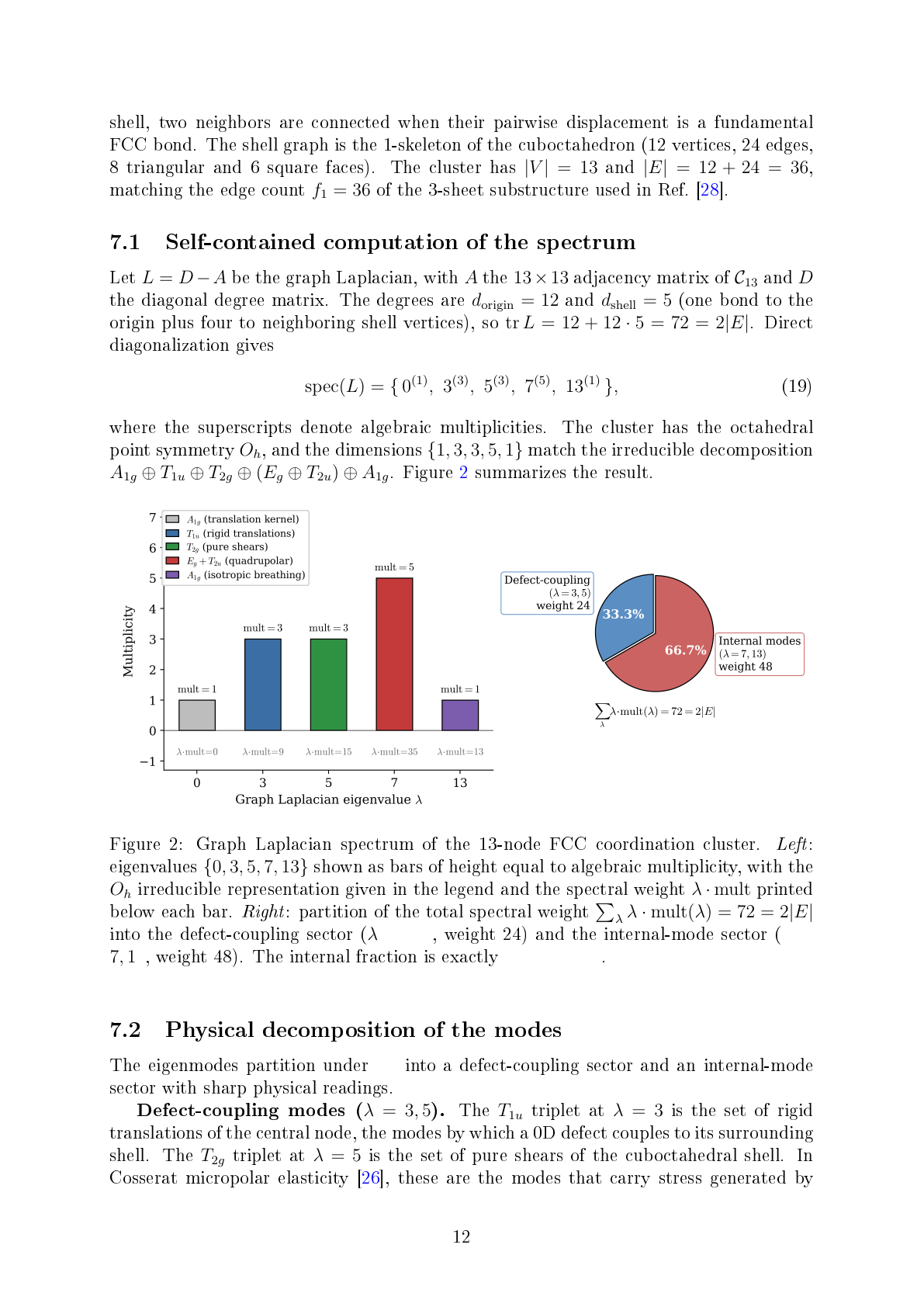
spec(L) = {0
(1)
, 3
(3)
, 5
(3)
, 7
(5)
, 13
(1)
},
(19)
where the superscripts denote algebraic multiplicities. The cluster has the octahedral
point symmetry
O
h
, and the dimensions
{1, 3, 3, 5, 1}
match the irreducible decomposition
A
1g
⊕ T
1u
⊕ T
2g
⊕ (E
g
⊕ T
2u
) ⊕ A
1g
. Figure 2 summarizes the result.
Figure 2: Graph Laplacian spectrum of the 13-node FCC coordination cluster.
Left
:
eigenvalues
{0, 3, 5, 7, 13}
shown as bars of height equal to algebraic multiplicity, with the
O
h
irreducible representation given in the legend and the spectral weight
λ ·mult
printed
below each bar.
Right
: partition of the total spectral weight
P
λ
λ · mult(λ) = 72 = 2|E|
into the defect-coupling sector (
λ = 3, 5
, weight 24) and the internal-mode sector (
λ =
7, 13
, weight 48). The internal fraction is exactly
48/72 = 2/3
.
7.2 Physical decomposition of the modes
The eigenmodes partition under
O
h
into a defect-coupling sector and an internal-mode
sector with sharp physical readings.
Defect-coupling modes (
λ = 3, 5
).
The
T
1u
triplet at
λ = 3
is the set of rigid
translations of the central node, the modes by which a 0D defect couples to its surrounding
shell. The
T
2g
triplet at
λ = 5
is the set of pure shears of the cuboctahedral shell. In
Cosserat micropolar elasticity [26], these are the modes that carry stress generated by
12
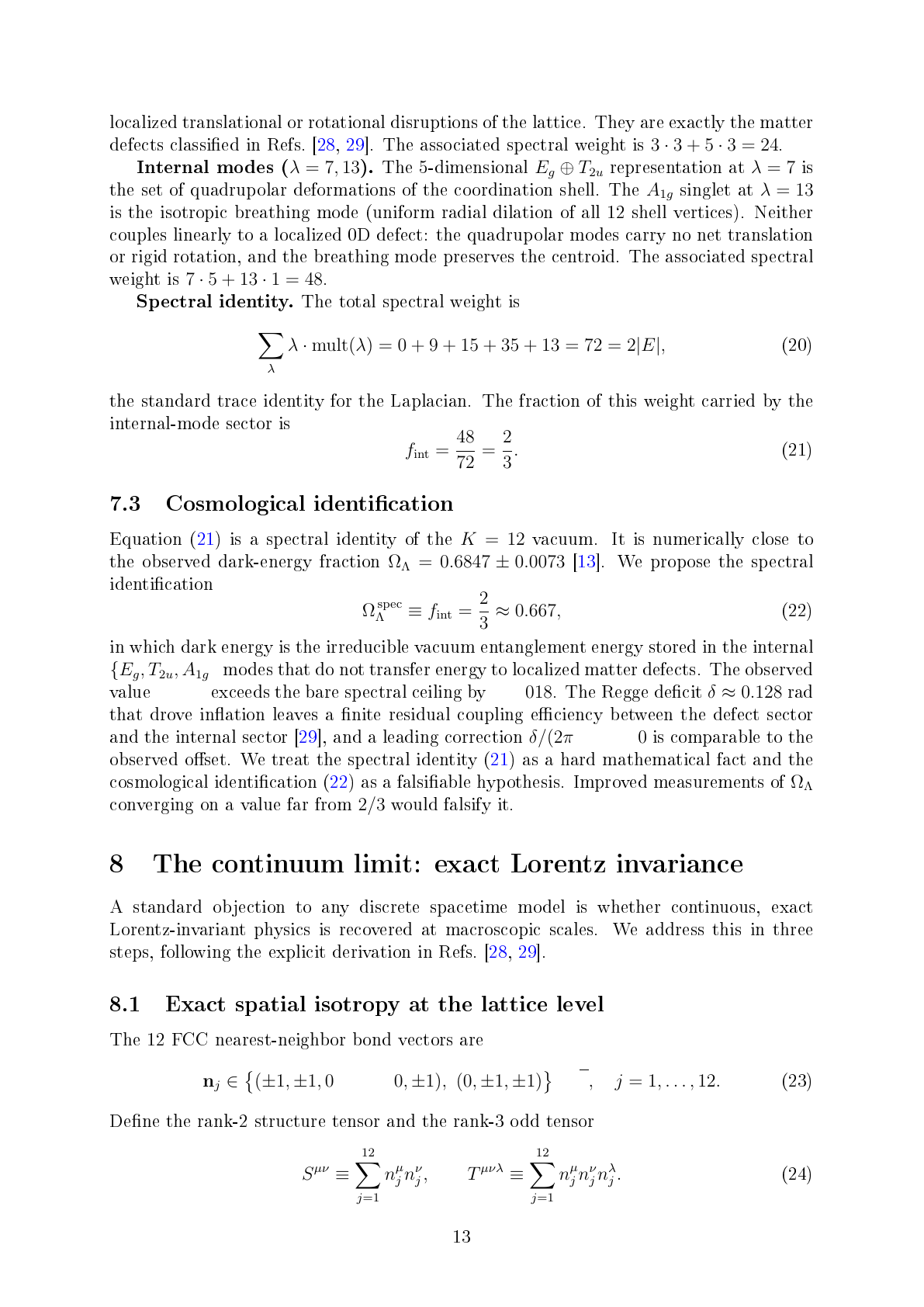
localized translational or rotational disruptions of the lattice. They are exactly the matter
defects classied in Refs. [28, 29]. The associated spectral weight is
3 · 3 + 5 · 3 = 24
.
Internal modes (
λ = 7, 13
).
The 5-dimensional
E
g
⊕ T
2u
representation at
λ = 7
is
the set of quadrupolar deformations of the coordination shell. The
A
1g
singlet at
λ = 13
is the isotropic breathing mode (uniform radial dilation of all 12 shell vertices). Neither
couples linearly to a localized 0D defect: the quadrupolar modes carry no net translation
or rigid rotation, and the breathing mode preserves the centroid. The associated spectral
weight is
7 · 5 + 13 · 1 = 48
.
Spectral identity.
The total spectral weight is
X
λ
λ · mult(λ) = 0 + 9 + 15 + 35 + 13 = 72 = 2|E|,
(20)
the standard trace identity for the Laplacian. The fraction of this weight carried by the
internal-mode sector is
f
int
=
48
72
=
2
3
.
(21)
7.3 Cosmological identication
Equation (21) is a spectral identity of the
K = 12
vacuum. It is numerically close to
the observed dark-energy fraction
Ω
Λ
= 0.6847 ± 0.0073
[13]. We propose the spectral
identication
Ω
spec
Λ
≡ f
int
=
2
3
≈ 0.667,
(22)
in which dark energy is the irreducible vacuum entanglement energy stored in the internal
{E
g
, T
2u
, A
1g
}
modes that do not transfer energy to localized matter defects. The observed
value
0.6847
exceeds the bare spectral ceiling by
∼ 0.018
. The Regge decit
δ ≈ 0.128
rad
that drove ination leaves a nite residual coupling eciency between the defect sector
and the internal sector [29], and a leading correction
δ/(2π) ≈ 0.020
is comparable to the
observed oset. We treat the spectral identity (21) as a hard mathematical fact and the
cosmological identication (22) as a falsiable hypothesis. Improved measurements of
Ω
Λ
converging on a value far from
2/3
would falsify it.
8 The continuum limit: exact Lorentz invariance
A standard objection to any discrete spacetime model is whether continuous, exact
Lorentz-invariant physics is recovered at macroscopic scales. We address this in three
steps, following the explicit derivation in Refs. [28, 29].
8.1 Exact spatial isotropy at the lattice level
The 12 FCC nearest-neighbor bond vectors are
n
j
∈
(±1, ±1, 0), (±1, 0, ±1), (0, ±1, ±1)
√
2, j = 1, . . . , 12.
(23)
Dene the rank-2 structure tensor and the rank-3 odd tensor
S
µν
≡
12
X
j=1
n
µ
j
n
ν
j
, T
µνλ
≡
12
X
j=1
n
µ
j
n
ν
j
n
λ
j
.
(24)
13
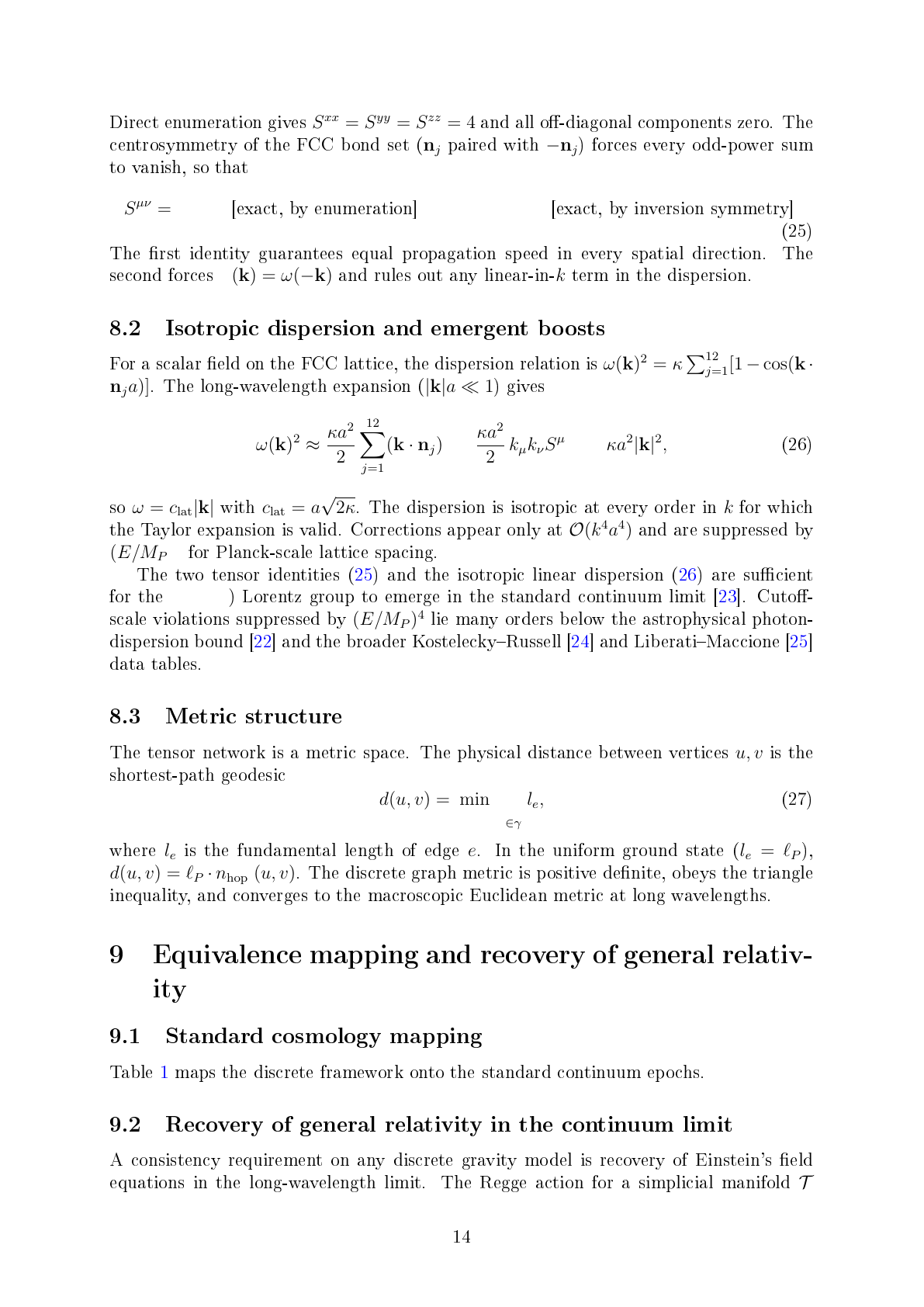
Direct enumeration gives
S
xx
= S
yy
= S
zz
= 4
and all o-diagonal components zero. The
centrosymmetry of the FCC bond set (
n
j
paired with
−n
j
) forces every odd-power sum
to vanish, so that
S
µν
= 4 δ
µν
[exact, by enumeration]
, T
µνλ
= 0
[exact, by inversion symmetry]
.
(25)
The rst identity guarantees equal propagation speed in every spatial direction. The
second forces
ω(k) = ω(−k)
and rules out any linear-in-
k
term in the dispersion.
8.2 Isotropic dispersion and emergent boosts
For a scalar eld on the FCC lattice, the dispersion relation is
ω(k)
2
= κ
P
12
j=1
[1 −cos(k ·
n
j
a)]
. The long-wavelength expansion (
|k|a ≪ 1
) gives
ω(k)
2
≈
κa
2
2
12
X
j=1
(k · n
j
)
2
=
κa
2
2
k
µ
k
ν
S
µν
= 2κa
2
|k|
2
,
(26)
so
ω = c
lat
|k|
with
c
lat
= a
√
2κ
. The dispersion is isotropic at every order in
k
for which
the Taylor expansion is valid. Corrections appear only at
O(k
4
a
4
)
and are suppressed by
(E/M
P
)
4
for Planck-scale lattice spacing.
The two tensor identities (25) and the isotropic linear dispersion (26) are sucient
for the
SO(3, 1)
Lorentz group to emerge in the standard continuum limit [23]. Cuto-
scale violations suppressed by
(E/M
P
)
4
lie many orders below the astrophysical photon-
dispersion bound [22] and the broader KosteleckyRussell [24] and LiberatiMaccione [25]
data tables.
8.3 Metric structure
The tensor network is a metric space. The physical distance between vertices
u, v
is the
shortest-path geodesic
d(u, v) = min
γ:u→v
X
e∈γ
l
e
,
(27)
where
l
e
is the fundamental length of edge
e
. In the uniform ground state (
l
e
= ℓ
P
),
d(u, v) = ℓ
P
·n
hops
(u, v)
. The discrete graph metric is positive denite, obeys the triangle
inequality, and converges to the macroscopic Euclidean metric at long wavelengths.
9 Equivalence mapping and recovery of general relativ-
ity
9.1 Standard cosmology mapping
Table 1 maps the discrete framework onto the standard continuum epochs.
9.2 Recovery of general relativity in the continuum limit
A consistency requirement on any discrete gravity model is recovery of Einstein's eld
equations in the long-wavelength limit. The Regge action for a simplicial manifold
T
14
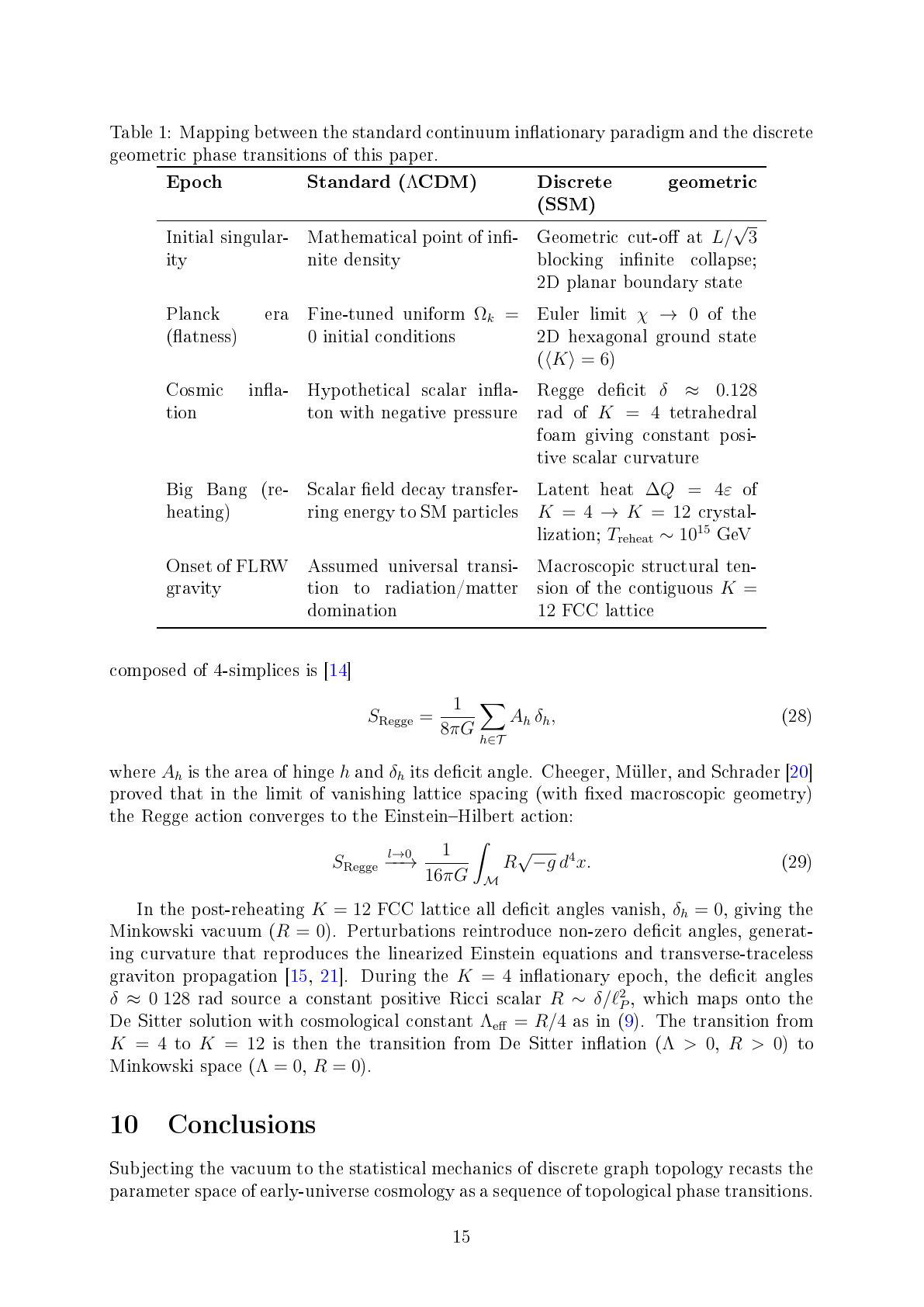
Table 1: Mapping between the standard continuum inationary paradigm and the discrete
geometric phase transitions of this paper.
Epoch Standard (
Λ
CDM) Discrete geometric
(SSM)
Initial singular-
ity
Mathematical point of in-
nite density
Geometric cut-o at
L/
√
3
blocking innite collapse;
2D planar boundary state
Planck era
(atness)
Fine-tuned uniform
Ω
k
=
0
initial conditions
Euler limit
χ → 0
of the
2D hexagonal ground state
(
⟨K⟩ = 6
)
Cosmic ina-
tion
Hypothetical scalar ina-
ton with negative pressure
Regge decit
δ ≈ 0.128
rad of
K = 4
tetrahedral
foam giving constant posi-
tive scalar curvature
Big Bang (re-
heating)
Scalar eld decay transfer-
ring energy to SM particles
Latent heat
∆Q = 4ε
of
K = 4 → K = 12
crystal-
lization;
T
reheat
∼ 10
15
GeV
Onset of FLRW
gravity
Assumed universal transi-
tion to radiation/matter
domination
Macroscopic structural ten-
sion of the contiguous
K =
12
FCC lattice
composed of 4-simplices is [14]
S
Regge
=
1
8πG
X
h∈T
A
h
δ
h
,
(28)
where
A
h
is the area of hinge
h
and
δ
h
its decit angle. Cheeger, Müller, and Schrader [20]
proved that in the limit of vanishing lattice spacing (with xed macroscopic geometry)
the Regge action converges to the EinsteinHilbert action:
S
Regge
l→0
−−→
1
16πG
Z
M
R
√
−g d
4
x.
(29)
In the post-reheating
K = 12
FCC lattice all decit angles vanish,
δ
h
= 0
, giving the
Minkowski vacuum (
R = 0
). Perturbations reintroduce non-zero decit angles, generat-
ing curvature that reproduces the linearized Einstein equations and transverse-traceless
graviton propagation [15, 21]. During the
K = 4
inationary epoch, the decit angles
δ ≈ 0.128
rad source a constant positive Ricci scalar
R ∼ δ/ℓ
2
P
, which maps onto the
De Sitter solution with cosmological constant
Λ
eff
= R/4
as in (9). The transition from
K = 4
to
K = 12
is then the transition from De Sitter ination (
Λ > 0
,
R > 0
) to
Minkowski space (
Λ = 0
,
R = 0
).
10 Conclusions
Subjecting the vacuum to the statistical mechanics of discrete graph topology recasts the
parameter space of early-universe cosmology as a sequence of topological phase transitions.
15
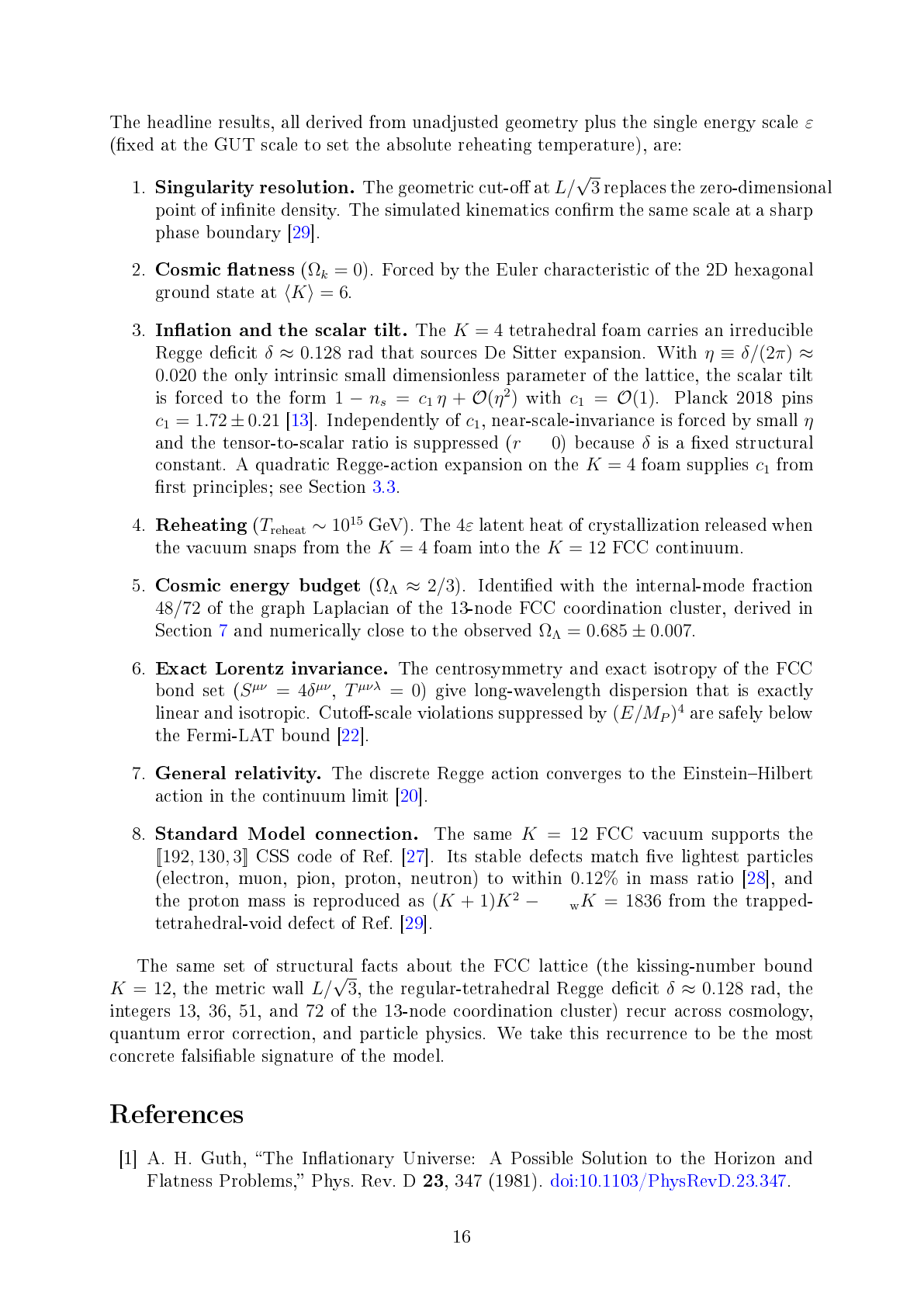
The headline results, all derived from unadjusted geometry plus the single energy scale
ε
(xed at the GUT scale to set the absolute reheating temperature), are:
1.
Singularity resolution.
The geometric cut-o at
L/
√
3
replaces the zero-dimensional
point of innite density. The simulated kinematics conrm the same scale at a sharp
phase boundary [29].
2.
Cosmic atness
(
Ω
k
= 0
). Forced by the Euler characteristic of the 2D hexagonal
ground state at
⟨K⟩ = 6
.
3.
Ination and the scalar tilt.
The
K = 4
tetrahedral foam carries an irreducible
Regge decit
δ ≈ 0.128
rad that sources De Sitter expansion. With
η ≡ δ/(2π) ≈
0.020
the only intrinsic small dimensionless parameter of the lattice, the scalar tilt
is forced to the form
1 − n
s
= c
1
η + O(η
2
)
with
c
1
= O(1)
. Planck 2018 pins
c
1
= 1.72 ±0.21
[13]. Independently of
c
1
, near-scale-invariance is forced by small
η
and the tensor-to-scalar ratio is suppressed (
r → 0
) because
δ
is a xed structural
constant. A quadratic Regge-action expansion on the
K = 4
foam supplies
c
1
from
rst principles; see Section 3.3.
4.
Reheating
(
T
reheat
∼ 10
15
GeV). The
4ε
latent heat of crystallization released when
the vacuum snaps from the
K = 4
foam into the
K = 12
FCC continuum.
5.
Cosmic energy budget
(
Ω
Λ
≈ 2/3
). Identied with the internal-mode fraction
48/72
of the graph Laplacian of the 13-node FCC coordination cluster, derived in
Section 7 and numerically close to the observed
Ω
Λ
= 0.685 ± 0.007
.
6.
Exact Lorentz invariance.
The centrosymmetry and exact isotropy of the FCC
bond set (
S
µν
= 4δ
µν
,
T
µνλ
= 0
) give long-wavelength dispersion that is exactly
linear and isotropic. Cuto-scale violations suppressed by
(E/M
P
)
4
are safely below
the Fermi-LAT bound [22].
7.
General relativity.
The discrete Regge action converges to the EinsteinHilbert
action in the continuum limit [20].
8.
Standard Model connection.
The same
K = 12
FCC vacuum supports the
[[192, 130, 3]]
CSS code of Ref. [27]. Its stable defects match ve lightest particles
(electron, muon, pion, proton, neutron) to within
0.12%
in mass ratio [28], and
the proton mass is reproduced as
(K + 1)K
2
− c
skew
K = 1836
from the trapped-
tetrahedral-void defect of Ref. [29].
The same set of structural facts about the FCC lattice (the kissing-number bound
K = 12
, the metric wall
L/
√
3
, the regular-tetrahedral Regge decit
δ ≈ 0.128
rad, the
integers
13
,
36
,
51
, and
72
of the 13-node coordination cluster) recur across cosmology,
quantum error correction, and particle physics. We take this recurrence to be the most
concrete falsiable signature of the model.
References
[1] A. H. Guth, The Inationary Universe: A Possible Solution to the Horizon and
Flatness Problems, Phys. Rev. D
23
, 347 (1981). doi:10.1103/PhysRevD.23.347.
16
[2] A. D. Linde, A New Inationary Universe Scenario, Phys. Lett. B
108
, 389393
(1982). doi:10.1016/0370-2693(82)91219-9.
[3] J. Maldacena and L. Susskind, Cool horizons for entangled black holes, Fortschr.
Phys.
61
, 781811 (2013). doi:10.1002/prop.201300020.
[4] B. Swingle, Entanglement renormalization and holography, Phys. Rev. D
86
,
065007 (2012). doi:10.1103/PhysRevD.86.065007.
[5] M. Van Raamsdonk, Building up spacetime with quantum entanglement, Gen. Rel.
Grav.
42
, 23232329 (2010). doi:10.1007/s10714-010-1034-0.
[6] R. Penrose, Angular momentum: an approach to combinatorial spacetime, in
Quan-
tum Theory and Beyond
, ed. T. Bastin, Cambridge Univ. Press (1971).
[7] C. Rovelli and L. Smolin, Spin networks and quantum gravity, Phys. Rev. D
52
,
5743 (1995). doi:10.1103/PhysRevD.52.5743.
[8] L. Bombelli, J. Lee, D. Meyer, and R. D. Sorkin, Space-time as a causal set, Phys.
Rev. Lett.
59
, 521 (1987). doi:10.1103/PhysRevLett.59.521.
[9] T. C. Hales, A Proof of the Kepler Conjecture, Ann. Math.
162
(3), 10651185
(2005). doi:10.4007/annals.2005.162.1065.
[10] R. H. Dicke and P. J. E. Peebles, The Big Bang cosmologyenigmas and nostrums,
in
General Relativity: An Einstein Centenary Survey
, eds. S. W. Hawking and W. Is-
rael, Cambridge Univ. Press (1979).
[11] J. D. Bekenstein, Black Holes and Entropy, Phys. Rev. D
7
, 23332346 (1973).
doi:10.1103/PhysRevD.7.2333.
[12] J. Ambjørn, J. Jurkiewicz, and R. Loll, Emergence of a 4D World
from Causal Dynamical Triangulations, Phys. Rev. Lett.
93
, 131301 (2004).
doi:10.1103/PhysRevLett.93.131301.
[13] Planck Collaboration, Planck 2018 results. VI. Cosmological parameters, Astron.
Astrophys.
641
, A6 (2020). doi:10.1051/0004-6361/201833910.
[14] T. Regge, General Relativity without Coordinates, Nuovo Cimento
19
, 558571
(1961). doi:10.1007/BF02733251.
[15] H. W. Hamber,
Quantum Gravity on the Lattice
, Cambridge University Press (2009).
doi:10.1017/CBO9780511920998.
[16] T. W. B. Kibble, Topology of cosmic domains and strings, J. Phys. A: Math. Gen.
9
, 1387 (1976). doi:10.1088/0305-4470/9/8/029.
[17] W. H. Zurek, Cosmological experiments in superuid helium?, Nature
317
, 505508
(1985). doi:10.1038/317505a0.
[18] R. Allahverdi, R. Brandenberger, F.-Y. Cyr-Racine, and A. Mazumdar, Reheating
in Inationary Cosmology: Theory and Applications, Ann. Rev. Nucl. Part. Sci.
60
,
2751 (2010). doi:10.1146/annurev.nucl.012809.104511.
17
[19] S. Coleman and F. De Luccia, Gravitational eects on and of vacuum decay, Phys.
Rev. D
21
, 3305 (1980). doi:10.1103/PhysRevD.21.3305.
[20] J. Cheeger, W. Müller, and R. Schrader, On the curvature of piecewise at spaces,
Commun. Math. Phys.
92
, 405454 (1984). doi:10.1007/BF01210729.
[21] H. W. Hamber and R. M. Williams, Higher derivative quantum gravity on a simpli-
cial lattice, Nucl. Phys. B
269
, 712 (1986). doi:10.1016/0550-3213(86)90518-3.
[22] Fermi LAT Collaboration, A limit on the variation of the speed of light arising from
quantum gravity eects, Nature
462
, 331334 (2009). doi:10.1038/nature08574.
[23] J. Collins, A. Perez, D. Sudarsky, L. Urrutia, and H. Vucetich, Lorentz invariance
and quantum gravity: an additional ne-tuning problem?, Phys. Rev. Lett.
93
,
191301 (2004). doi:10.1103/PhysRevLett.93.191301.
[24] V. A. Kostelecky and N. Russell, Data tables for Lorentz and CPT violation, Rev.
Mod. Phys.
83
, 11 (2011). doi:10.1103/RevModPhys.83.11.
[25] S. Liberati and L. Maccione, Lorentz violation: motivation and new constraints,
Ann. Rev. Nucl. Part. Sci.
59
, 245 (2009). doi:10.1146/annurev.nucl.010909.083640.
[26] A. C. Eringen,
Microcontinuum Field Theories I: Foundations and Solids
, Springer
(1999). doi:10.1007/978-1-4612-0555-5.
[27] R. Kulkarni, A 67%-Rate CSS Code on the FCC Lattice:
[[192, 130, 3]]
from Weight-
12 Stabilizers, arXiv:2603.20294 (2026).
[28] R. Kulkarni, The Mass-Energy-Information equivalence: a bottom-up identication
of the particle spectrum via FCC lattice error correction, Physics Open
27
, 100414
(2026). doi:10.1016/j.physo.2026.100414.
[29] R. Kulkarni, Matter as incomplete crystallization: quark charges, color connement,
and the proton mass from a single extra node in the vacuum lattice, Physics Open
27
, 100423 (2026). doi:10.1016/j.physo.2026.100423.
18
