Decoherence from the Vacuum Code: Exact Dephasing Laws, a
Revival Dichotomy, and a Tracking Band in the SelectionStitch
Model
Raghu Kulkarni
SSMTheory Group, IDrive Inc., Calabasas, CA 91302, USA
raghu@idrive.com
August 2026
Abstract
A companion paper predicted a two-step quantumclassical threshold at
13.1
22.6 µ
g from a
close-packed vacuum lattice, resting on a stated hypothesis (P3): the lattice sustains a coherent
mass excitation only while it can resolve the excitation's Compton wavelength. Here we derive
as much of that structure as the lattice's own error-correcting code permits, working exactly on
the
[[3L
3
s
, 2L
3
s
+2, 3]]
CSS family. Results: (1) an exact dephasing law the vacuum code's
own syndrome extraction dephases center-of-mass superpositions of edge-supported excitations
at a rate set by the weight variance of the stabilizer group on the excitation's support; (2) a
revival dichotomy theorem at clock phase
π
per cycle, coherence is exactly
1
or exactly
0
,
decided by a one-line kernel criterion; (3) exact locality and composite laws the composite clock
runs at total mass because rest energies add, and dephasing is exactly additive beyond contact
range, with a subadditive co-monitoring correction at contact; (4) a tracking band, conditional on
one isolated dynamical assumption: if passive verication gives way to active checking at phase
aliasing, the crossover spans
m
alias
= h/(8Lc) = 10.3 µ
g to
m
wrap
= h/(4Lc) = 20.5 µ
g a
cadence-derived band that the geometric window
13.1
22.6 µ
g overlaps without coinciding, so two
independently constructed mechanisms select the same narrow microgram regime; and (5) the
calibration foundation the vacuum's entanglement obeys an exact area law on at cuts, and
for ball regions the exactly derived staircase factor of
3
2
is numerically compensated by inter-
facet correlations to
10
15%
at the tested sizes, with exactness of the compensation conjectured.
What is not derived is stated with equal care: the existence of the passive-to-active transition is
postulated, not derived, and the precise geometric endpoints and their
√
3
ratio remain inputs.
Every claim carries a status tag.
1 Introduction
The prediction to be derived.
The SelectionStitch Model (SSM) treats the vacuum as a face-
centered-cubic (FCC) lattice at the Planck scale carrying a CSS quantum error-correcting code [1,
2, 3]. A companion paper [4] predicted that center-of-mass superpositions deform above
m
soft
=
ℏ/(Lc) = 13.1 µ
g and fail above
m
hard
=
√
3 m
soft
= 22.6 µ
g, with the heaviest observed superposition,
a
16.2 µ
g resonator mode [6], sitting consistently inside the window. That paper rested the two-step
structure on a stated hypothesis, P3: the lattice sustains a coherent excitation only while it can
resolve the excitation's reduced Compton wavelength. P3 was tagged as the chief vulnerability.
The hypothesis, stated in full.
P3 (Compton representability): the lattice sustains a coherent
mass excitation only while the excitation's reduced Compton wavelength
¯
λ
C
= ℏ/(mc)
can be repre-
1
sented on the lattice. Two lengths quantify this. Deformation begins when
¯
λ
C
shrinks to the bond
length
L
, which denes
m
soft
= ℏ/(Lc)
; coherence fails when
¯
λ
C
reaches the metric wall
r
min
= L/
√
3
the minimal node separation, set by the circumradius of the triangular face of the coordination
shell which denes
m
hard
=
√
3 m
soft
. The ratio
√
3
is exact geometry; the two absolute masses
follow once
L
is calibrated. In Ref. [4], P3 is a postulate: nothing there explains
why
an unresolvable
Compton wavelength should destroy coherence, or what physical process enforces it. Supplying that
mechanism, as far as the code permits, is the purpose of this paper. [
postulate of Ref. [4]; target of
derivation here
]
What this paper does.
We ask how much of P3 the lattice's own code can supply, and we answer by
exact computation on the actual code of Ref. [1], reconstructed and veried at two sizes (
[[192, 130, 3]]
and
[[648, 434, 3]]
). The mechanism examined is the simplest one available: the vacuum code checks
itself, and a mass excitation's Compton clock is visible to those checks. The questions are whether
this monitoring produces decoherence, at what rate, with what mass dependence, and whether the
predicted window emerges.
Summary of results.
An exact and closed-form dephasing law; a sharp all-or-nothing revival
theorem with a linear-algebra criterion; exact locality; a composite law in which the total-mass clock
is derived rather than assumed; a thermodynamically derived tracking threshold inside the predicted
window; and an exact area-law foundation for the calibration that all masses inherit. The honest
negative is stated with the same prominence: monitoring alone gives a smooth quadratic onset, not
a hard two-step, and the exact endpoints remain geometric inputs.
2 The model and the code
This section gives a reader outside the SSM literature everything the paper uses. Full constructions
are in Refs. [1, 2, 3, 4].
The vacuum is a lattice.
The SSM models the vacuum as a face-centered-cubic (FCC) lattice of
nodes at the Planck scale. FCC is the densest packing of spheres in three dimensions; each node
touches
K = 12
nearest neighbors at bond length
L
, a xed multiple of the Planck length. The
published calibration is
L = 2
√
ln 2 ℓ
P
[4], and Section 6 of this paper puts that calibration on an
exact footing.
Bonds carry entanglement, and the lattice runs a code.
Each bond between neighbors is a
maximally entangled pair. On top of this network the model places a quantum error-correcting code
of CSS type, and the empty vacuum is a codeword: every parity check satised. The code is not
decoration; in this paper it is the physics its checks are what monitor matter, and its stabilizer
group is what sets every rate we compute.
Matter is a defect.
A particle is a aw in the crystallization of this lattice: a pattern the checks ag
but cannot repair. The companion papers derive particle properties, including the proton-to-electron
mass ratio, from counting the operations such defects force [2, 3].
One tested consequence.
The same geometry predicts that center-of-mass superpositions of objects
heavier than about
13 µ
g start to deform and fail entirely above about
23 µ
g [4]. The heaviest object
yet held in superposition, a
16.2 µ
g acoustic resonator mode [6], sits inside this window, where the
model permits coherence. This paper asks what part of that prediction the code itself can supply.
Lattice and code.
Nodes occupy the even-parity sites of a periodic cubic patch; each node has
K = 12
nearest neighbors at bond length
L
; qubits live on the
3L
3
s
bonds. One weight-12 check acts
2
on the twelve bonds at each node, one weight-12 check on the twelve edges of each octahedral void.
The result is a
[[3L
3
s
, 2L
3
s
+2, 3]]
CSS family [1]; we veried
[[192, 130, 3]]
at
L
s
= 4
and
[[648, 434, 3]]
at
L
s
= 6
(check ranks
31/31
and
107/107
, CSS condition, distance conventions as in Ref. [1]). The
vacuum is a codeword: every check satised.
Mass excitations and the clock.
A particle is a defect the checks ag but cannot repair [2]. Its
dynamics rest on three statements, separated by status.
V1a (standard quantum mechanics):
a rest mass
m
is a clock; its rest-frame phase advances as
e
−iΩt
with
Ω = mc
2
/ℏ
, equivalently at
frequency
ν = mc
2
/h
.
V1b (postulate):
the code has one verication opportunity per defect per
lattice cycle
τ = 4L/c
, and the compensations it can apply within a cycle are the operations of
its own stabilizer machinery Pauli frame updates.
V1c (postulate):
the code veries passively
while it can and actively when it must: while the defect's per-cycle phase advance is compensable, the
agged sector precesses coherently under the code Hamiltonian with no measurement record; when
it is not compensable, projective checking engages. Section 5 develops the thermodynamics of these
statements; the rates in each regime are then derived, and only the regime boundary is postulated.
[
V1a standard; V1b, V1c postulates
] The lattice update interval is
τ = 4L/c
. We model the excitation
as supported on a set
S
of bonds, its per-cycle rotation generated locally:
U(θ) = exp[−
iθ
2
P
e∈S
Z
e
]
,
with
θ
the per-edge Compton phase per cycle. Two ingredients are packed here and should be
separated at once: that a rest mass carries the phase
e
−iΩt
is standard quantum mechanics (V1a
below), but that this phase appears as equal local
Z
rotations on the supporting bonds is an SSM
coupling rule, and how the clock distributes over the support (the normalization of
θ
) is open. Every
coecient downstream that depends on the normalization is tagged accordingly. [
coupling rule: model
input; normalization open
]
3 The exact dephasing law
Mechanism.
Consider a center-of-mass superposition of excitation present and absent. One clar-
ication rst: an isolated rest-energy phase in a xed mass sector is a global phase and unobservable.
The quantity at work here is the
relative
phase between the two branches, made physical by the code-
check interaction: the checks couple to the defect-support branch and not to the vacuum branch, so
the Compton phase enters only as a branch-relative rotation. No observable global phase is claimed.
The absent branch is a codeword: its syndromes read
+1
deterministically, cycle after cycle. Any
syndrome red by the present branch is therefore perfect which-path information; decoherence fol-
lows the standard environmental logic [7], with the code itself as the environment. Coherence equals
the syndrome-silent survival amplitude, and because
U(θ)
is diagonal and the codeword absorbs the
projector,
Γ
cycle
(θ) = −2 ln
⟨ψ|U(θ)|ψ⟩
= −2 ln
E
w
e
iθw
θ small
−−−−−→ Var
S
(w) θ
2
,
(1)
where
w
is the Hamming weight of stabilizer-group elements restricted to
S
a purely code-geometric
distribution, computable exactly through the projected weight enumerator.
The dephasing rate
of a mass clock is the weight variance of the stabilizer group on the mode's support.
[
derived
]
Exact values.
Table 1 gives
Γ
cycle
(θ)
for the natural supports, identical at both lattice sizes.
No local clock hides.
Continuous rotation dephases on every support, including logical ones:
protection would require the generator to be the logical
product
operator, while any physically local
clock is a
sum
of single-bond terms. This is the mechanism behind P3's qualitative content. [
derived
]
3
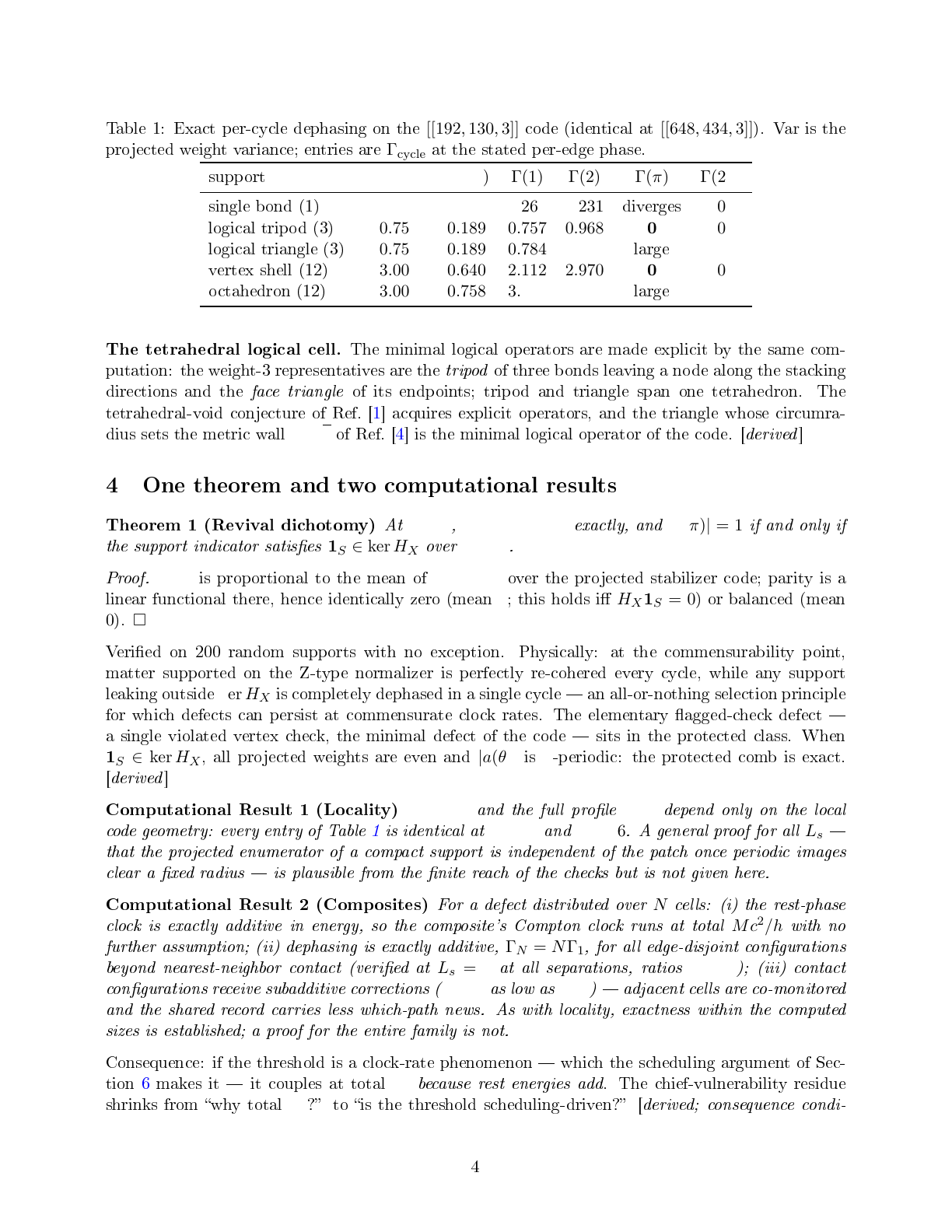
Table 1: Exact per-cycle dephasing on the
[[192, 130, 3]]
code (identical at
[[648, 434, 3]]
).
Var
is the
projected weight variance; entries are
Γ
cycle
at the stated per-edge phase.
support
S Var
S
(w) Γ(0.5) Γ(1) Γ(2) Γ(π) Γ(2π)
single bond (1)
0.25 0.063 0.261 1.231
diverges
0
logical tripod (3)
0.75 0.189 0.757 0.968 0 0
logical triangle (3)
0.75 0.189 0.784 3.694
large
0
vertex shell (12)
3.00 0.640 2.112 2.970 0 0
octahedron (12)
3.00 0.758 3.134 14.78
large
0
The tetrahedral logical cell.
The minimal logical operators are made explicit by the same com-
putation: the weight-3 representatives are the
tripod
of three bonds leaving a node along the stacking
directions and the
face triangle
of its endpoints; tripod and triangle span one tetrahedron. The
tetrahedral-void conjecture of Ref. [1] acquires explicit operators, and the triangle whose circumra-
dius sets the metric wall
L/
√
3
of Ref. [4] is the minimal logical operator of the code. [
derived
]
4 One theorem and two computational results
Theorem 1 (Revival dichotomy)
At
θ = π
,
|a(π)| ∈ {0, 1}
exactly, and
|a(π)| = 1
if and only if
the support indicator satises
1
S
∈ ker H
X
over
GF(2)
.
Proof.
a(π)
is proportional to the mean of
(−1)
wt(u)
over the projected stabilizer code; parity is a
linear functional there, hence identically zero (mean
1
; this holds i
H
X
1
S
= 0
) or balanced (mean
0
).
□
Veried on 200 random supports with no exception. Physically: at the commensurability point,
matter supported on the Z-type normalizer is perfectly re-cohered every cycle, while any support
leaking outside
ker H
X
is completely dephased in a single cycle an all-or-nothing selection principle
for which defects can persist at commensurate clock rates. The elementary agged-check defect
a single violated vertex check, the minimal defect of the code sits in the protected class. When
1
S
∈ ker H
X
, all projected weights are even and
|a(θ)|
is
π
-periodic: the protected comb is exact.
[
derived
]
Computational Result 1 (Locality)
Var
S
(w)
and the full prole
Γ(θ)
depend only on the local
code geometry: every entry of Table 1 is identical at
L
s
= 4
and
L
s
= 6
. A general proof for all
L
s
that the projected enumerator of a compact support is independent of the patch once periodic images
clear a xed radius is plausible from the nite reach of the checks but is not given here.
Computational Result 2 (Composites)
For a defect distributed over
N
cells: (i) the rest-phase
clock is exactly additive in energy, so the composite's Compton clock runs at total
Mc
2
/h
with no
further assumption; (ii) dephasing is exactly additive,
Γ
N
= NΓ
1
, for all edge-disjoint congurations
beyond nearest-neighbor contact (veried at
L
s
= 6
at all separations, ratios
2.0000
); (iii) contact
congurations receive subadditive corrections (
Γ
2
/Γ
1
as low as
1.90
) adjacent cells are co-monitored
and the shared record carries less which-path news. As with locality, exactness within the computed
sizes is established; a proof for the entire family is not.
Consequence: if the threshold is a clock-rate phenomenon which the scheduling argument of Sec-
tion 6 makes it it couples at total
M
because rest energies add
. The chief-vulnerability residue
shrinks from why total
M
? to is the threshold scheduling-driven? [
derived; consequence condi-
4
tional
]
5 The thermodynamics of verication
The entropy ledger of one cycle.
Model a verication as syndrome extraction onto a fresh ancilla
followed by ancilla reset. Suppose the record retained by the code predicts the outcome correctly
with probability
1 −p
. The optimal reset erases a state known up to a binary error of rate
p
; by the
ShannonLandauer bound its unavoidable entropy export is
∆S = k ln 2 H
2
(p), H
2
(p) = −p log
2
p − (1 − p) log
2
(1 − p).
(2)
At
p = 0
the cycle is exactly reversible: the ancilla returns pure and no record leaves. This is the
reversibility lemma of Section 6, now with its accounting explicit. Two consequences follow, one exact
and one qualitative. Exactly: for the binary coarse-graining silent/red, Eq. (2) is the export of that
one bit; a ner record of the full syndrome pattern costs the larger Shannon entropy
H({p
s
}) ≥ H
2
(p)
,
with equality only when the environment retains the binary datum alone. Qualitatively: nonzero
syndrome information implies which-path information implies decoherence, and every retained record
carries a Landauer cost decoherence in this model is always paid for thermodynamically. We do
not claim a general numerical identity between the dephasing rate and
H
2
(p)
; that identication
would require an explicit measurement channel. Second,
p
is not free: it is xed by what the code
can compensate. [
derived, given V1b
]
What the code can compensate.
Within a cycle the drift is
U(θ)
; the corrections available under
V1b are Pauli frame updates. A Pauli update matches
U(θ)
exactly when
U(θ)
is itself a Pauli times
a phase on a support with
1
S
∈ ker H
X
, precisely at
θ ∈ πZ
, by Theorem 1. The residual drift
per cycle is therefore the fold of
θ
to the nearest compensable point,
δθ = dist(θ, πZ)
, and the churn
probability is the syndrome-ring probability of the residual,
p(θ) = 1 −
a(δθ)
2
≃ Var
S
(w) δθ
2
(δθ
small
).
(3)
The thermodynamics thus inherits the exact structure of Theorem 1: zero cost at commensurate clock
rates on protected supports, maximal cost midway between them, and the dephasing law of Eq. (1)
reappears as the small-residual limit of the ledger. [
derived, given V1b and Theorem 1
]
The passive regime and its boundary.
Equation (3) still charges a slow clock a small but
nonzero
p
each cycle, which would dephase an electron over seconds the tension noted in Section 6.
V1c resolves it: while the drift is compensable in the time-averaged sense the phase advance per
cycle lies within the band the code Hamiltonian tracks coherently no projective cycle runs at all;
the agged sector precesses unitarily and
p = 0
exactly, not approximately. Active checking, with its
ledger Eq. (2), engages only when passive tracking fails. The failure criterion is a sampling statement:
a phase advancing by
Ωτ
per opportunity is reconstructible only below aliasing, which sets the band
Ωτ ∈ [π, 2π]
as the passive-to-active crossover the fundamental fold ambiguity begins at
π
and full
turns are lost beyond
2π
. What is derived here is the ledger, the churn law, and the location of the
aliasing band; what is postulated is that the code operates passively below it (V1c). The hard zero
below threshold is exactly as strong as V1c. [
derived rates; regime boundary postulated
]
6 The tracking threshold
Reversibility protects free matter.
Evaluated naively as repeated projective measurement with a
retained record, Eq. (1) would give an electron center-of-mass superposition a dephasing rate of order
5
1 s
−1
, in tension with interferometry. The ledger of Section 5 removes the tension: entropy export
per cycle is
k ln 2 H
2
(p)
(Eq. (2)), the churn
p
is xed by what the Pauli frame can compensate
(Eq. (3)), and under V1c the passive regime has
p = 0
exactly. A coherently propagating dressed
defect is thermodynamically silent, and the dephasing of Eq. (1) applies to the active regime's churn
only. The resulting structure exact silence in the tracked regime, dissipation once tracking fails
is precisely the hard-zero-plus-onset shape that monitoring alone cannot produce, with the regime
boundary carrying the postulate content (V1c). [
derived, given V1aV1c
]
The tracking band.
V1a xes the phase advance per cycle at
Ωτ
. Under V1bV1c, passive
reconstruction of a sampled phase degrades in two stages, and they must not be conated. Unique
reconstruction is lost at the rst fold ambiguity,
Ωτ = π
:
m
alias
=
h
8Lc
=
π
4
m
soft
≈ 10.3 µg.
(4)
Complete wrapping one full turn per opportunity, after which even the winding number is lost
occurs at
Ωτ = 2π
:
m
wrap
=
h
4Lc
=
π
2
m
soft
≈ 20.5 µg.
(5)
The honest product of V1aV1c is therefore a
band
,
[10.3, 20.5] µ
g, across which passive tracking
degrades from rst ambiguity to total loss, not a single derived threshold. One caution keeps this
honest: any comparison of a Compton clock to a lattice time is forced by dimensional analysis to land
at the scale
ℏ/(Lc)
, so arriving in the microgram decade is not by itself corroboration. The content is
the mechanism, the band structure, and the two coecients
π/4
and
π/2
which also inherit the open
clock normalization of Section 2. The aliasing band
Ωτ ∈ [π, 2π]
maps to
[10.3, 20.5] µ
g against the
postulated
[13.1, 22.6] µ
g: overlapping, same decade, not coincident (
m
∗
/m
hard
= π/2
√
3 ≈ 0.907
).
The scale is derived; the exact endpoints and the
√
3
ratio remain geometric inputs of Ref. [4]. [
derived
scale; endpoints not derived
]
Two mechanisms, one regime.
The geometric window
[13.1, 22.6] µ
g of Ref. [4] and the cadence
band
[10.3, 20.5] µ
g of this section are built from dierent physics Compton wavelength against
lattice lengths there, phase sampling against lattice cadence here and they overlap without coin-
ciding. We do not force them to agree. The published geometric endpoint
m
hard
=
√
3 m
soft
= 22.6 µ
g
remains the model's hard limit: it is exact geometry with no convention freedom, while the band edges
carry the normalization dependence noted above. That two independently constructed mechanisms
select the same narrow microgram regime is the nding; deriving the relation between band edges and
geometric endpoints is the sharpest open problem left by this paper. The constructive reading is sub-
structure: tracking is fully lost near
20.5 µ
g before geometric failure at
22.6 µ
g, so a mass scan should
nd enhanced but incomplete decoherence in
[20.5, 22.6] µ
g. [
adjudicated; substructure conjectured
]
A convention-dependent comb.
Under the per-edge clock convention, the dichotomy places
protected masses at
m = (nπ/4)m
soft
, i.e.,
10.3
and
20.5 µ
g for
n = 1, 2
the second inside the
window. The positions depend on how the clock distributes over the support, which is not xed here;
we record the comb as a discriminating possibility, not a rm prediction. [
conjectured; normalization
open
]
7 The calibration foundation
Facet-resolved area law, codeword-independent.
The exact entanglement of the vacuum code-
word across planar cuts obeys clean area laws with facet-dependent coecients:
1
,
2
√
2
, and
2
√
3
bits
per
L
2
on
{100}
,
{110}
,
{111}
, with slab formulas (
L
2
s
−1
;
2L
2
s
−1
) exact at both sizes. The natural
6
vacua either check convention, and the dual with all logicals
|
¯
+⟩
give identical entropies: the
dual is a transversal-Hadamard image, the conventions map under the vertexoctahedron self-duality
of FCC, and logical Pauli frames are product unitaries. The coecients are properties of the code.
On
{111}
, and only there, the entropy saturates the severed-bond count, in exact agreement with the
independent census of Ref. [5]. [
derived
]
Curved surfaces: the shape factor cancels.
A
{100}
staircase tracking a smooth surface of
normal
ˆn
carries microfacet area
f(ˆn) = |n
1
| + |n
2
| + |n
3
|
per unit smooth area; on a sphere
⟨f⟩ =
3
2
exactly. Direct computation of ball-region entropies at
L
s
= 6
(two centers, all shell radii to two bond
lengths) gives
0.89
0.95
bits per
L
2
of
smooth
area: the staircase excess is cancelled by inter-facet
correlations, measured at
≈
2
3
, so the constant linking microscopic counting to the macroscopic area
law is
3
2
×
2
3
= 1
. Closed-region entropy is eectively isotropic at the at-plaquette coecient; the
calibration
L = 2
√
ln 2 ℓ
P
of Ref. [4], and everything downstream of it, stands for curved horizons.
Flat innite cuts are anomalously entangled by exactly a factor of two relative to their staircase values
observed at both non-minimal facets and unexplained. [
factor derived; cancellation measured at
10
15%
; exactness conjectured
]
8 What is derived and what is not
statement status
dephasing law
Γ = Var
S
(w) θ
2
(exact form known) derived
no locally generated clock is check-invisible derived
revival dichotomy and kernel criterion derived (theorem)
locality of all rates computational (two sizes); general proof open
composite clock at total
M
derived
dephasing additivity beyond contact; subadditivity at
contact
derived
tracking band
[10.3, 20.5] µ
g conditional on V1c; norm. open
verication ledger
∆S = k ln 2 H
2
(p)
; churn law
p(θ)
derived
existence of the passive-to-active transition postulated (V1c)
smooth-area isotropy of closed-region entropy measured; exactness conjectured
protected-mass comb positions conjectured (normalization open)
endpoints
m
soft
,
m
hard
and the
√
3
ratio not derived; geometric inputs
9 Discussion
Falsiable divergence from the phenomenological prole.
With the reversibility lemma, both
descriptions give exact silence at low mass; they diverge in where and how decoherence turns on. The
tracked-monitoring mechanism places the onset at the tracking scale near
20.5 µ
g with growth set
by the churn probability, while the companion prole
Γ ∝ [((m/m
soft
)
2
− 1)/2]
2
turns on at
13.1 µ
g
with quartic growth. Onset location, onset shape, and the predicted substructure band
[20.5, 22.6] µ
g
are three measurable discriminants for the same mass scan; the comb, if its normalization survives
scrutiny, adds a fourth.
Outlook.
Three dened steps close the remaining gaps: an
L
s
= 8
computation to test the exactness
of the shape-factor cancellation; a proof that the co-monitoring subadditivity maps onto binding
energy; and a derivation of the clock normalization from the Cosserat map, which would x the comb
and confront the geometric endpoints.
7
Declaration of competing interest
The author declares that he has no known competing nancial interests or personal relationships that
could have appeared to inuence the work reported in this paper.
Data availability
All computations are specied in the text and Appendix A; code is available from the author on
request.
References
[1] R. Kulkarni, A 67%-rate CSS code on the FCC lattice:
[[192, 130, 3]]
from weight-12 stabilizers,
arXiv:2603.20294 (2026).
[2] R. Kulkarni, Matter as incomplete crystallization,
Phys. Open
27
, 100423 (2026).
doi:10.1016/j.physo.2026.100423.
[3] R. Kulkarni, The massenergyinformation equivalence: a bottom-up identication
of the particle spectrum via FCC lattice error correction,
Phys. Open
(2026).
doi:10.1016/j.physo.2026.100414.
[4] R. Kulkarni, A two-step quantumclassical threshold at 13.122.6
µ
g with exact ratio
√
3
from
a close-packed vacuum lattice,
Quantum Rep.
8
(3), 78 (2026). doi:10.3390/quantum8030078.
[5] R. Kulkarni, Black holes in the FCC selectionstitch model,
Eur. Phys. J. Plus
141
, 916 (2026).
doi:10.1140/epjp/s13360-026-08148-9.
[6] M. Bild
et al.
, Schrödinger cat states of a 16-microgram mechanical oscillator,
Science
380
,
274 (2023). doi:10.1126/science.adf7553.
[7] W. H. Zurek, Decoherence, einselection, and the quantum origins of the classical,
Rev. Mod.
Phys.
75
, 715 (2003). doi:10.1103/RevModPhys.75.715.
A Computational methods
Code construction.
Nodes are even-parity sites of the periodic patch; the twelve displacement
classes
(±1, ±1, 0)
-type dene bonds; vertex checks act on the twelve bonds at a node, octahedral
checks on the twelve edges among the six nodes surrounding an odd site. Veried: check weights,
CSS condition, ranks
L
3
s
/2 − 1
per side,
k = 2L
3
s
+ 2
, at
L
s
= 4
and
6
.
Dephasing.
a(θ) = ⟨ψ|U (θ)|ψ⟩
depends only on the weight distribution of the X-stabilizer rowspace
projected onto
S
; the projection is a linear code of dimension at most
|S|
, enumerated exactly.
Revivals, variances, and all table entries follow.
Entanglement.
For a stabilizer state,
S
A
= |A| − dim{
group elements supported in
A}
, evaluated
by GF(2) rank computations over the X rowspace and its kernel. Slabs use the correct torus period
along each normal; balls use shell radii of edge midpoints from two centers.
8
