Dark Matter Quantum Numbers from Interstitial Site
Symmetry:
Electromagnetic Neutrality and Self-Conjugacy from the
Centrosymmetry of the Octahedral Void
Raghu Kulkarni
*
SSMTheory Group, IDrive Inc., Calabasas, CA 91302, USA
June 2026
Abstract
In the Selection-Stitch Model (SSM), baryonic matter and dark matter are trapped nodes
in the two interstitial voids of the FCC vacuum lattice: the proton in the tetrahedral void,
the dark matter candidate in the octahedral void. The companion papers derive the masses
and the color structure of both defects from the combinatorics of their bonded graphs.
Here we identify a second, distinct structural origin for the remaining quantum numbers.
We show that the electromagnetic and matter/antimatter properties of a trapped defect
are xed not by its bonded graph but by the point-group symmetry of its interstitial
site
,
and that a single discriminatorwhether the site is an inversion centerseparates the two
sectors. The octahedral void is centrosymmetric (
O
h
); the tetrahedral void is not (
T
d
).
We prove that centrosymmetry forces the rst-order electric dipole moment to vanish as a
protected selection rule, valid for
any
charge arrangement consistent with the site symmetry,
not merely the symmetric one. Under a stated identication of charge conjugation with
the site's parity structure, the same centrosymmetry forces the defect to be self-conjugate
(Majorana-type) [4]. The non-centrosymmetric tetrahedral site provides neither protection:
its dipole is generic and a distinct antiparticle exists, matching the proton. Extending the
analysis to the full multipole tower, we nd that the magnetic dipole is also forbiddennot
by centrosymmetry, to which an axial vector is blind, but by the cubic rotational symmetry
and, more robustly, by self-conjugacyand that the unique surviving electromagnetic form
factor is a momentum-suppressed anapole moment, the one coupling a Majorana particle can
carry. We are explicit about the epistemic status of each resultthe dipole theorem is pure
geometry; the self-conjugacy theorem rests on the stated charge-conjugation modeland
we show that the color property does
not
reduce to site symmetry but to the bonded-graph
combinatorics of the companion work. The electromagnetic and conjugation properties of
dark matter thus follow from one geometric fact: the dark defect occupies an inversion center
of the vacuum lattice.
1 Introduction
The Selection-Stitch Model (SSM) [1, 2] treats the physical vacuum as a face-centered cubic
(FCC) crystallization of spacetime, and matter as the places where that crystallization is in-
complete: a node trapped below bulk coordination at an interstitial site, unable to stitch into
the surrounding lattice. The FCC lattice provides exactly two interstitial void types, and the
*
raghu@idrive.com
1
program identies a particle with each. The proton is a
K = 4
remnant in the tetrahedral
void [1]; the dark matter candidate is a
K = 6
remnant in the octahedral void [3].
The masses of both defects, and the color structure of the proton, are derived in the com-
panion papers from the combinatorics of the defect's bonded graph: the proton-to-electron mass
ratio from the tetrahedral graph
K
4
, the dark matter mass from the octahedral graph
K
2,2,2
,
and the three QCD colors from the skew-pair count of
K
4
. These are
internal
propertiesthey
depend on how the defect's own bonds are arranged, and they are computed by counting on the
graph.
This paper isolates a second and structurally distinct origin for the
remaining
quantum
numbers. We show that the electromagnetic behavior and the matter/antimatter (conjugation)
character of a trapped defect are xed not by its bonded graph but by the point-group symmetry
of the interstitial
site
it occupiesa property of the defect's
placement
in the lattice rather than
of its internal bonding. The central observation is that a single feature of the sitewhether
it is an inversion centerseparates the two sectors and accounts, by one mechanism, for two
properties that the companion work states but does not derive in this way.
The octahedral void is centrosymmetric: it possesses a center of inversion, and its point
group is
O
h
. The tetrahedral void is not: it has no inversion center, and its point group is
T
d
.
We prove that this dierence forces the dark defect's rst-order electric dipole moment to vanish
identically, as a selection rule protected by the site symmetry, while the proton's site provides no
such protection. Under a stated identication of charge conjugation with the parity structure
of the site, the same centrosymmetry forces the dark defect to be its own antiparticle, while
the proton's non-centrosymmetric site admits a distinct antiparticle. We are careful throughout
to separate what follows from pure geometry from what follows under a physical model, and
we show explicitly that the color property belongs to the graph-combinatorial category, not the
site-symmetry one.
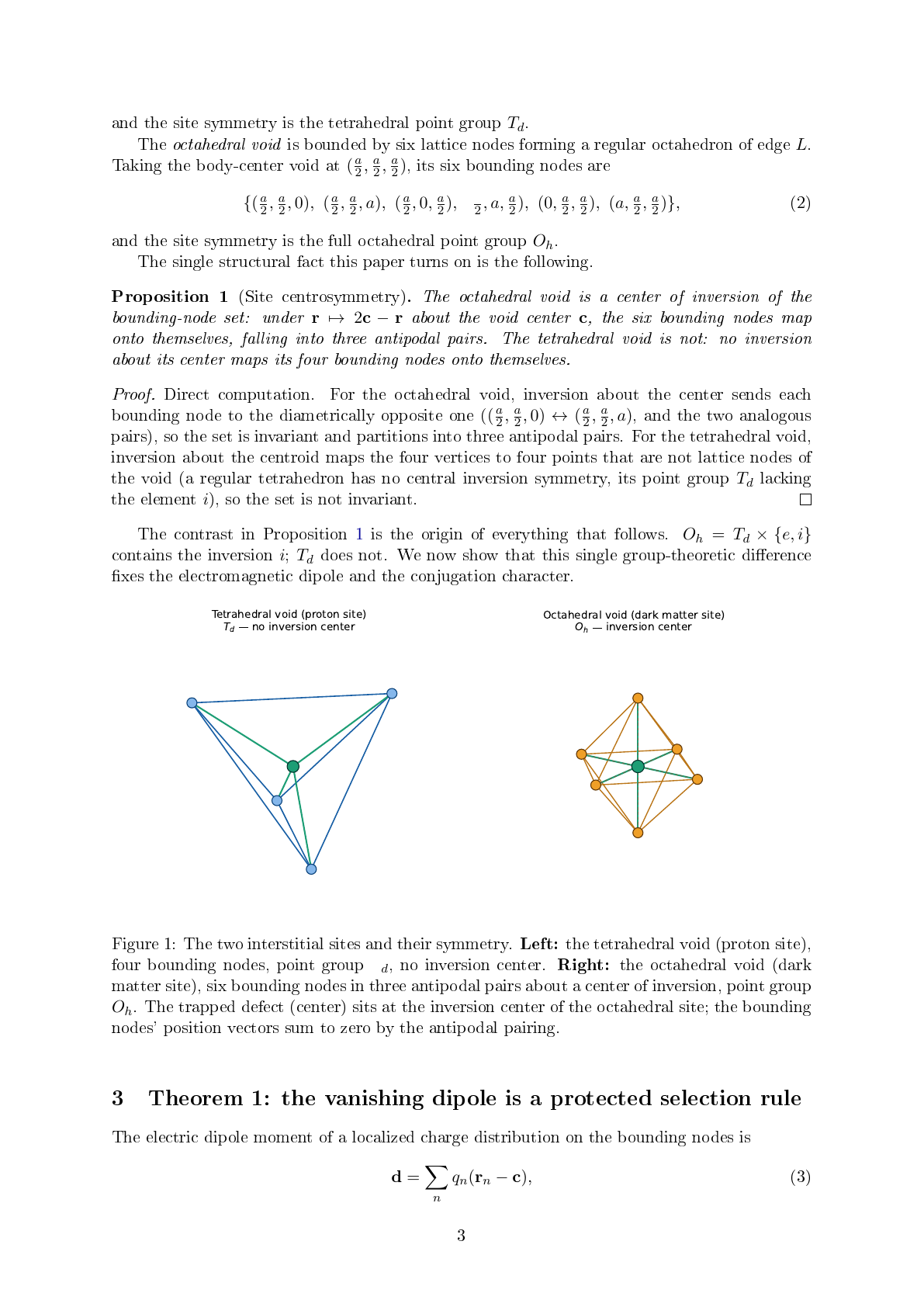
The picture that organizes the paper is the contrast between the two defects' placements.
The tetrahedral remnant sits within a single coordination cluster of the lattice; the octahedral
remnant sits symmetrically about an inversion center, its six bounding nodes falling into three
antipodal pairs (Figure 1). It is this symmetric placementvisualizable as a defect shared evenly
across the interface between adjacent cellsthat carries the electromagnetic and conjugation
content. The remainder of the paper makes that statement precise.
What this paper claims, and does not.
We claim that (i) the octahedral interstitial site is
centrosymmetric and the tetrahedral is not; (ii) centrosymmetry forces the vanishing of the rst-
order electric dipole as a protected selection rule, which we prove as pure geometry; (iii) under
a stated charge-conjugation model, centrosymmetry forces self-conjugacy; (iv) the permanent
magnetic dipole and the low multipoles are likewise forbidden, with the anapole the unique
surviving electromagnetic moment; and (v) the color property does not reduce to site symmetry
but to the bonded-graph combinatorics of Refs. [1, 3]. We do not claim that all quantum
numbers reduce to a single fact; on the contrary, we identify two distinct structural origins and
assign each property to its own. We do not re-derive the masses, which are established in the
companion work and used here only as context.
2 The two interstitial sites and their point groups
The FCC lattice with cubic constant
a
has atoms at the cube corners and face centers, with
nearest-neighbor distance
L = a/
√
2
. It admits two interstitial void types.
The
tetrahedral void
is bounded by four lattice nodes forming a regular tetrahedron of edge
L
. Taking the representative void at
(a/4)(1, 1, 1)
, its four bounding nodes are
{(0, 0, 0), (
a
2
,
a
2
, 0), (
a
2
, 0,
a
2
), (0,
a
2
,
a
2
)},
(1)
2
and the site symmetry is the tetrahedral point group
T
d
.
The
octahedral void
is bounded by six lattice nodes forming a regular octahedron of edge
L
.
Taking the body-center void at
(
a
2
,
a
2
,
a
2
)
, its six bounding nodes are
{(
a
2
,
a
2
, 0), (
a
2
,
a
2
, a), (
a
2
, 0,
a
2
), (
a
2
, a,
a
2
), (0,
a
2
,
a
2
), (a,
a
2
,
a
2
)},
(2)
and the site symmetry is the full octahedral point group
O
h
.
The single structural fact this paper turns on is the following.
Proposition 1
(Site centrosymmetry)
.
The octahedral void is a center of inversion of the
bounding-node set: under
r 7→ 2c − r
about the void center
c
, the six bounding nodes map
onto themselves, falling into three antipodal pairs. The tetrahedral void is not: no inversion
about its center maps its four bounding nodes onto themselves.
Proof.
Direct computation. For the octahedral void, inversion about the center sends each
bounding node to the diametrically opposite one (
(
a
2
,
a
2
, 0) ↔ (
a
2
,
a
2
, a)
, and the two analogous
pairs), so the set is invariant and partitions into three antipodal pairs. For the tetrahedral void,
inversion about the centroid maps the four vertices to four points that are not lattice nodes of
the void (a regular tetrahedron has no central inversion symmetry, its point group
T
d
lacking
the element
i
), so the set is not invariant.
The contrast in Proposition 1 is the origin of everything that follows.
O
h
= T
d
× {e, i}
contains the inversion
i
;
T
d
does not. We now show that this single group-theoretic dierence
xes the electromagnetic dipole and the conjugation character.
Tetrahedral void (proton site)
T
d
no inversion center
Octahedral void (dark matter site)
O
h
inversion center
Figure 1: The two interstitial sites and their symmetry.
Left:
the tetrahedral void (proton site),
four bounding nodes, point group
T
d
, no inversion center.
Right:
the octahedral void (dark
matter site), six bounding nodes in three antipodal pairs about a center of inversion, point group
O
h
. The trapped defect (center) sits at the inversion center of the octahedral site; the bounding
nodes' position vectors sum to zero by the antipodal pairing.
3 Theorem 1: the vanishing dipole is a protected selection rule
The electric dipole moment of a localized charge distribution on the bounding nodes is
d =
X
n
q
n
(r
n
− c),
(3)
3
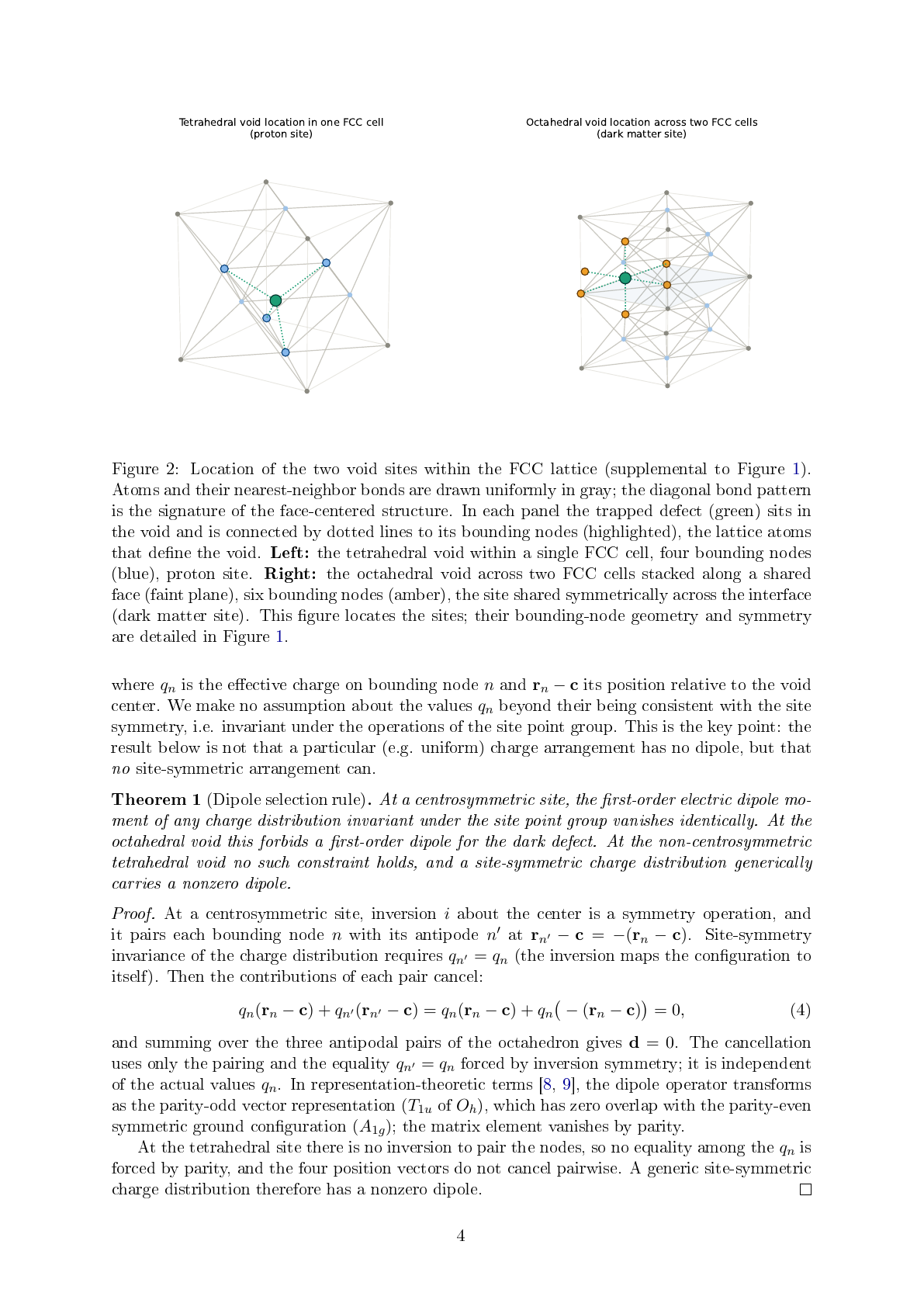
Tetrahedral void location in one FCC cell
(proton site)
Octahedral void location across two FCC cells
(dark matter site)
Figure 2: Location of the two void sites within the FCC lattice (supplemental to Figure 1).
Atoms and their nearest-neighbor bonds are drawn uniformly in gray; the diagonal bond pattern
is the signature of the face-centered structure. In each panel the trapped defect (green) sits in
the void and is connected by dotted lines to its bounding nodes (highlighted), the lattice atoms
that dene the void.
Left:
the tetrahedral void within a single FCC cell, four bounding nodes
(blue), proton site.
Right:
the octahedral void across two FCC cells stacked along a shared
face (faint plane), six bounding nodes (amber), the site shared symmetrically across the interface
(dark matter site). This gure locates the sites; their bounding-node geometry and symmetry
are detailed in Figure 1.
where
q
n
is the eective charge on bounding node
n
and
r
n
− c
its position relative to the void
center. We make no assumption about the values
q
n
beyond their being consistent with the site
symmetry, i.e. invariant under the operations of the site point group. This is the key point: the
result below is not that a particular (e.g. uniform) charge arrangement has no dipole, but that
no
site-symmetric arrangement can.
Theorem 1
(Dipole selection rule)
.
At a centrosymmetric site, the rst-order electric dipole mo-
ment of any charge distribution invariant under the site point group vanishes identically. At the
octahedral void this forbids a rst-order dipole for the dark defect. At the non-centrosymmetric
tetrahedral void no such constraint holds, and a site-symmetric charge distribution generically
carries a nonzero dipole.
Proof.
At a centrosymmetric site, inversion
i
about the center is a symmetry operation, and
it pairs each bounding node
n
with its antipode
n
′
at
r
n
′
− c = −(r
n
− c)
. Site-symmetry
invariance of the charge distribution requires
q
n
′
= q
n
(the inversion maps the conguration to
itself). Then the contributions of each pair cancel:
q
n
(r
n
− c) + q
n
′
(r
n
′
− c) = q
n
(r
n
− c) + q
n
− (r
n
− c)
= 0,
(4)
and summing over the three antipodal pairs of the octahedron gives
d = 0
. The cancellation
uses only the pairing and the equality
q
n
′
= q
n
forced by inversion symmetry; it is independent
of the actual values
q
n
. In representation-theoretic terms [8, 9], the dipole operator transforms
as the parity-odd vector representation (
T
1u
of
O
h
), which has zero overlap with the parity-even
symmetric ground conguration (
A
1g
); the matrix element vanishes by parity.
At the tetrahedral site there is no inversion to pair the nodes, so no equality among the
q
n
is
forced by parity, and the four position vectors do not cancel pairwise. A generic site-symmetric
charge distribution therefore has a nonzero dipole.
4
We veried Theorem 1 numerically as a guard against algebraic error: over
5000
random
charge assignments to the octahedral nodes, each made inversion-symmetric by equating an-
tipodal pairs, the dipole magnitude was zero to machine precision (
< 10
−15
); over
5000
random
charge assignments to the tetrahedral nodes, the dipole magnitude ranged from
0.009
to
0.456
in units of
L
, i.e. generically nonzero.
The physical reading is that the dark defect's electromagnetic neutrality at leading (dipole)
order is not a property that must be arranged but one that cannot be avoided: it is protected by
the centrosymmetry of the site. The proton's site oers no such protection, consistent with the
proton's nonzero charge structure derived in Ref. [1]. We emphasize the scope: this establishes
the absence of a
rst-order dipole
coupling. It does not exclude higher-multipole, loop-induced,
or mediated electromagnetic interactions, which remain open and are expected to be present
but suppressed; the claim is neutrality at leading order, protected by parity.
4 Theorem 2: self-conjugacy from the site's parity structure
A particle is self-conjugate (Majorana-type) when it carries no conserved label that charge
conjugation
C
would reverse to produce a distinct antiparticle. In the lattice-defect picture, the
labels that distinguish a baryon from its antibaryonfractional electric charge and colorare
orientational (signed) assignments on the defect's bonds, and the antiparticle is the sign-reversed
conguration. The defect is self-conjugate precisely when no such signed assignment survives
the site symmetry.
To make this precise we must state what
C
is at the level of a lattice defect. We adopt
the identication, consistent with the parity-sector analysis of the electromagnetic coupling in
Ref. [1] and with the particle/antiparticle picture of the SSM, that charge conjugation acts on
the signed bond labels as the site's inversion (parity) operation acts on the bounding nodes:
C
reverses the orientation that inversion would exchange. This is a physical model of
C
, not a
theorem, and we ag it as such; the result below holds under this identication.
Theorem 2
(Self-conjugacy at a centrosymmetric site)
.
Under the stated identication of charge
conjugation with the site's parity structure, a defect at a centrosymmetric site carries no signed
(particle versus antiparticle) charge: its symmetric conguration is invariant under
C
, so the
defect equals its own conjugate and is self-conjugate. A defect at a non-centrosymmetric site is
not so constrained and admits a distinct antiparticle.
Proof.
Decompose any bond labeling
q
on the bounding nodes into parts even and odd under
the site inversion,
q = q
(g)
+ q
(u)
, with
q
(g)
=
1
2
(q + P q)
and
q
(u)
=
1
2
(q − P q)
, where
P
is the
inversion (antipodal exchange). The signed,
C
-odd contentthe part that distinguishes particle
from antiparticle under the stated identicationis
q
(u)
. At a centrosymmetric site, the physical
defect occupies the symmetric ground conguration, which is inversion-invariant:
P q
(g)
= q
(g)
,
hence its odd content is
(q
(g)
− P q
(g)
)/2 = 0
. There is no signed charge to reverse;
C
acts
trivially and the defect is self-conjugate. At a non-centrosymmetric site there is no inversion
pairing, the decomposition into
g
and
u
sectors under a site inversion does not exist, and a
signed labeling is unconstrained: a distinct
C
-conjugate conguration exists, and the defect is
not self-conjugate.
We veried the computation underlying Theorem 2: projecting
5000
random symmetric con-
gurations of the octahedral nodes onto their inversion-odd part returned zero to machine preci-
sion, conrming that no signed charge survives the centrosymmetric site. The result matches the
phenomenology the companion work assigns to the two sectors: the proton (tetrahedral, non-
centrosymmetric) has a distinct antiproton, while the dark defect (octahedral, centrosymmetric)
is its own antiparticlea Majorana-type dark matter candidate requiring no particle/antiparticle
asymmetry in the dark sector.
5
We restate the epistemic status plainly. Theorem 1 is pure geometry: it uses only the antipo-
dal pairing and parity, with no physical model beyond the identication of the dipole operator
with the position-weighted charge sum. Theorem 2 additionally requires the identication of
charge conjugation with the site's parity structure, which is a physical model. A reader who
rejects that identication retains Theorem 1 in full; the self-conjugacy result stands or falls with
the model of
C
, and we present it as such.
5 The multipole tower: which electromagnetic moments survive
Theorem 1 forbids the rst-order electric dipole. It is natural to ask how far the prohibition
extendswhether a magnetic dipole, or a higher multipole, could carry a faint electromagnetic
signature accessible to direct-detection experiments. The answer requires care, because the
electric and magnetic dipoles transform dierently under inversion, and the centrosymmetry
argument of Theorem 1 does
not
transfer directly to the magnetic case. We work through the
leading moments and identify exactly what is forbidden, by which symmetry, and what survives.
Electric versus magnetic dipole: dierent transformations.
The electric dipole
d
is a
polar vector: under inversion
i
it changes sign,
d 7→ −d
, which is precisely why a centrosym-
metric site forbids it (Theorem 1). The magnetic dipole
µ
is an axial (pseudo)vector: under
inversion it is
invariant
,
µ 7→ +µ
. Inversion alone therefore places no constraint on a magnetic
dipole, and the argument of Theorem 1 cannot be carried over to it. Centrosymmetry is blind
to axial vectors.
The magnetic dipole is nonetheless forbidden, by two independent routes.
First, by
the full point group: in
O
h
a polar vector transforms as
T
1u
and an axial vector as
T
1g
, and
neither contains the trivial representation
A
1g
. A permanent moment requires its operator to
contain
A
1g
, so the static
O
h
site supports neither a permanent electric nor a permanent magnetic
dipole. The electric prohibition is carried by the inversion element; the magnetic prohibition is
carried by the cubic rotational axes. The conclusion is the same but the mechanism is dierent,
and we are explicit about which symmetry does the work in each case.
Second, and more robustly, by self-conjugacy: a magnetic dipole moment reverses sign under
charge conjugation,
µ 7→ −µ
. If the dark defect is the self-conjugate (Majorana-type) state of
Theorem 2, a permanent magnetic dipole is forbidden by
C
-invariance: the moment would have
to equal its own negative. The same fact that makes the defect its own antiparticle forbids its
magnetic dipole. This route does not depend on the spatial point group at all, and it shows
that Theorem 2, granted its premise, does more than establish self-conjugacy: it closes the
magnetic-dipole channel as well.
The higher tower.
The same
A
1g
criterion disposes of the next moments. The electric
quadrupole transforms as
E
g
+ T
2g
and the magnetic quadrupole as
T
2u
+ T
1u
under
O
h
; neither
contains
A
1g
, so both permanent quadrupoles are forbidden. The electric monopole (charge)
transforms as
A
1g
and is therefore symmetry-allowed, but it is set to zero independently by the
neutrality established in the companion work [3]. The permanent-multipole tower is thus empty
through the orders that direct detection would probe coherently.
What survives: the anapole.
One electromagnetic form factor remains compatible with all
of the above, and it is the unique one a Majorana particle can carry [5, 6, 7]: the anapole (toroidal
dipole) moment. The anapole is parity-odd and charge-conjugation-odd, the same quantum
numbers as the source current
J
rather than the charge density, and it is the single moment that
survives self-conjugacy. Physically it corresponds to a toroidal current congurationa solenoid
6
bent into a ringand it couples not to the electromagnetic eld directly but to its sources,
i.e. to the nuclear current in a scattering event. Its hallmark is momentum suppression: the
anapole coupling vanishes as the momentum transfer
q → 0
, scaling as
q
2
relative to a standard
charge coupling, which gives a recoil-energy dependence distinct from ordinary spin-independent
scattering.
The anapole is therefore the one genuine, if faint, electromagnetic handle on this candidate.
We state its status precisely. Its existence is contingent on the defect being spin-
1
2
: a scalar
(spin-
0
) defect has no magnetic moment and no anapole, so this channel presumes the fermionic
interpretation that underlies Theorem 2. And while symmetry
permits
the anapole, it does not
x its
magnitude
: the coupling strength depends on how the defect couples to lattice currents,
which is not derived here and which we identify, consistently with the companion work, as
awaiting the defect's strain prole. The result of this section is thus a symmetry statementthe
permanent electric and magnetic dipoles and the low multipoles are forbidden, the anapole alone
is allowedand not yet a prediction of an observable rate. A defect that is electromagnetically
silent at every permanent-multipole order, and whose only allowed coupling is a momentum-
suppressed anapole, is by construction extraordinarily weakly interacting, consistent with its
having escaped detection.
6 Why color does not reduce to site symmetry
It is natural to ask whether the remaining quantum numbercoloralso reduces to the site
symmetry, completing a single-fact account of the property list. It does not, and the reason
is instructive: it locates color rmly in the graph-combinatorial category rather than the site-
symmetry one.
In the SSM the three QCD colors arise because the tetrahedral graph
K
4
has exactly three
skew (disjoint) edge pairs, in bijection with three conning channels [1]. The octahedral graph
K
2,2,2
has thirty skew pairs, with no three-fold bijection, so the baryonic color-generating mech-
anism does not carry over [3]. These countsthree and thirtyare properties of the bonded
graphs, established by direct enumeration.
One might hope to recover them from the site point groups, but the attempt fails cleanly.
Both site groups possess three-dimensional irreducible representations:
T
d
has two (
T
1
and
T
2
),
and
O
h
has four (
T
1g
, T
2g
, T
1u
, T
2u
). The existence of a three-dimensional irrep therefore does
not distinguish the two sites and cannot, by itself, explain why the tetrahedral defect carries
three colors and the octahedral does not. The decisive quantity is the skew-pair count, which is
combinatorial, not the parity structure that xes the dipole and the conjugation character.
The site symmetry does
illuminate
the color structure without
determining
it. Under
O
h
the thirty octahedral skew pairs split into two orbits, of sizes six and twenty-four, and neither
is a three-element orbit; this is consistent with the absence of a three-color bijection. Under
T
d
the three tetrahedral skew pairs form a single orbit of size three, consistent with their bijection
to three colors. So the orbit structure under the site group is in harmony with the color count,
but the count itself is set by the graph combinatorics of the companion work, not by whether
the site is an inversion center.
This is the cleanest statement of the paper's architecture. A trapped defect's quantum
numbers have two structural origins. The mass and the color follow from the combinatorics
of the bonded graphthey are internal properties, xed by how the defect's own bonds are
arranged. The electromagnetic dipole and the conjugation character follow from the point-
group symmetry of the sitethey are placement properties, xed by where the defect sits in
the lattice. The inversion center is the discriminator for the second category and the second
category only.
7
7 Discussion
The result of this paper is a partition. The qualitative properties that distinguish the dark octa-
hedral defect from the baryonic tetrahedral one fall into two groups with two distinct structural
origins. The mass and the absence of the baryonic color mechanism are graph-combinatorial:
they are computed by counting on the bonded graph, and they are derived in the companion
papers [1, 3]. The electromagnetic and conjugation propertiesthe vanishing electric dipole,
the self-conjugate character, the forbidden magnetic dipole and low multipoles, and the anapole
as the lone survivorare site-symmetric: they follow from one fact, that the octahedral void is
a center of inversion while the tetrahedral void is not. The electromagnetic content reduces to
a single statement: the defect is silent at every permanent-multipole order, and its only allowed
coupling is a momentum-suppressed anapole, contingent on the fermionic interpretation.
The asymmetry in rigor between the two site-symmetric results is real and worth restating.
The dipole selection rule (Theorem 1) is pure geometry, as rm as the parity argument that
forbids a permanent dipole in any centrosymmetric system. The self-conjugacy result (Theo-
rem 2) is a theorem under a stated identication of charge conjugation with the site's parity
structure; it is as secure as that identication, which we regard as physically natural but do
not derive from a more primitive principle. A sharpened account of charge conjugation in the
SSMideally one that derives the action of
C
on bond labels from the lattice dynamics rather
than positing itwould settle the status of the self-conjugacy result, and we identify it as the
natural next step.
One implication of Theorem 1 deserves to be drawn out, because it marks a genuine departure
from how neutrality is understood in the Standard Model. There, a particle's electric neutrality
follows from the Gell-MannNishijima relation
Q = T
3
+ Y /2
: it requires a specic arrangement
of weak isospin and hypercharge assignments, the hypercharge tied to the electroweak and
Higgs sector, and those assignments are further constrained by anomaly cancellation across a
fermion generation. Neutrality is, in that account, an electroweak and representation-theoretic
statement. The mechanism here is entirely dierent. The dark defect's neutrality follows from
the inversion symmetry of its interstitial sitepure three-dimensional spatial geometrywith
no reference to weak isospin, hypercharge, a Higgs coupling, or anomaly cancellation. The
bounding-node contributions sum to zero because the site is a center of inversion, and that
is the whole of it. The dark sector's electromagnetic quietness is therefore decoupled from
the electroweak sector: it need not participate in anomaly cancellation and requires no tuned
Higgs-sector charge assignment to be neutral. We state the scope precisely. This is a geometric
protection of neutrality at the level of the dipole and the permanent multipole tower (Section 5),
not a derivation of a quantized total charge from electroweak principles; the anapole survives
and loop-induced couplings remain open, so the defect is electromagnetically quiet rather than
sterile. What is geometric is the
mechanism
of neutrality, and that mechanism owes nothing to
the electroweak structure that supplies it in the Standard Model.
The broader signicance is for the coherence of the program. The companion papers show
that one mechanisma node trapped in an interstitial voidyields both the proton and the
dark matter candidate, with their masses xed by the respective graph counts. This paper
adds that the same geometry xes their electromagnetic and conjugation properties through a
single, orthogonal discriminator: the symmetry of the site. The matter sector occupies a non-
centrosymmetric site and is charged, colored, and has a distinct antiparticle; the dark sector
occupies a centrosymmetric site and is dipole-free and self-conjugate. The contrast between
visible and dark matter, in this picture, is at bottom the contrast between two interstitial sites
of one latticeone with a center of inversion and one without.
8
Data and code availability
The single self-contained Python script
verify_quantum_numbers.py
(NumPy only) reproduces
every computational claim in this paper: Proposition 1 (site centrosymmetry), Theorem 1 (the
dipole selection rule and the tetrahedral contrast), Theorem 2 (self-conjugacy under the stated
charge-conjugation identication), the skew-pair counts and orbit split of Section 6, and the mul-
tipole/anapole bookkeeping of Section 5. The script is available in the SSMTheory repository:
https://github.com/raghu91302/ssmtheory/blob/main/verify_quantum_numbers.py
References
[1] R. Kulkarni,
Matter as Incomplete Crystallization: Quark Charges, Color Connement, and
the Proton Mass from a Single Extra Node in the Vacuum Lattice
, Phys. Open
27
, 100423
(2026).
https://doi.org/10.1016/j.physo.2026.100423
[2] R. Kulkarni,
The mass-energy-information equivalence: A bottom-up identication of the
particle spectrum via FCC lattice error correction
, Phys. Open
27
, 100414 (2026).
https:
//doi.org/10.1016/j.physo.2026.100414
[3] R. Kulkarni,
Dark Matter as Incomplete Crystallization: Neutrality, Abundance, and a 1.719
GeV Mass from the Octahedral Void
, SSMTheory Group, IDrive Inc., Calabasas, CA (2026).
https://doi.org/10.5281/zenodo.20047901
[4] E. Majorana,
Teoria simmetrica dell'elettrone e del positrone
, Nuovo Cimento
14
, 171 (1937).
https://doi.org/10.1007/BF02961314
[5] Ya. B. Zel'dovich,
Electromagnetic interaction with parity violation
, Sov. Phys. JETP
6
, 1184
(1958).
[6] C. M. Ho and R. J. Scherrer,
Anapole Dark Matter
, Phys. Lett. B
722
, 341 (2013).
https:
//doi.org/10.1016/j.physletb.2013.04.039
[7] A. Ibarra, M. Reichard, and others,
Anapole Moment of Majorana Fermions and Implications
for Direct Detection
, arXiv:2207.01014 (2022).
https://arxiv.org/abs/2207.01014
[8] M. Tinkham,
Group Theory and Quantum Mechanics
, McGraw-Hill, New York (1964); Dover
reprint (2003).
[9] M. S. Dresselhaus, G. Dresselhaus, and A. Jorio,
Group Theory: Application to
the Physics of Condensed Matter
, Springer, Berlin (2008).
https://doi.org/10.1007/
978-3-540-32899-5
9
